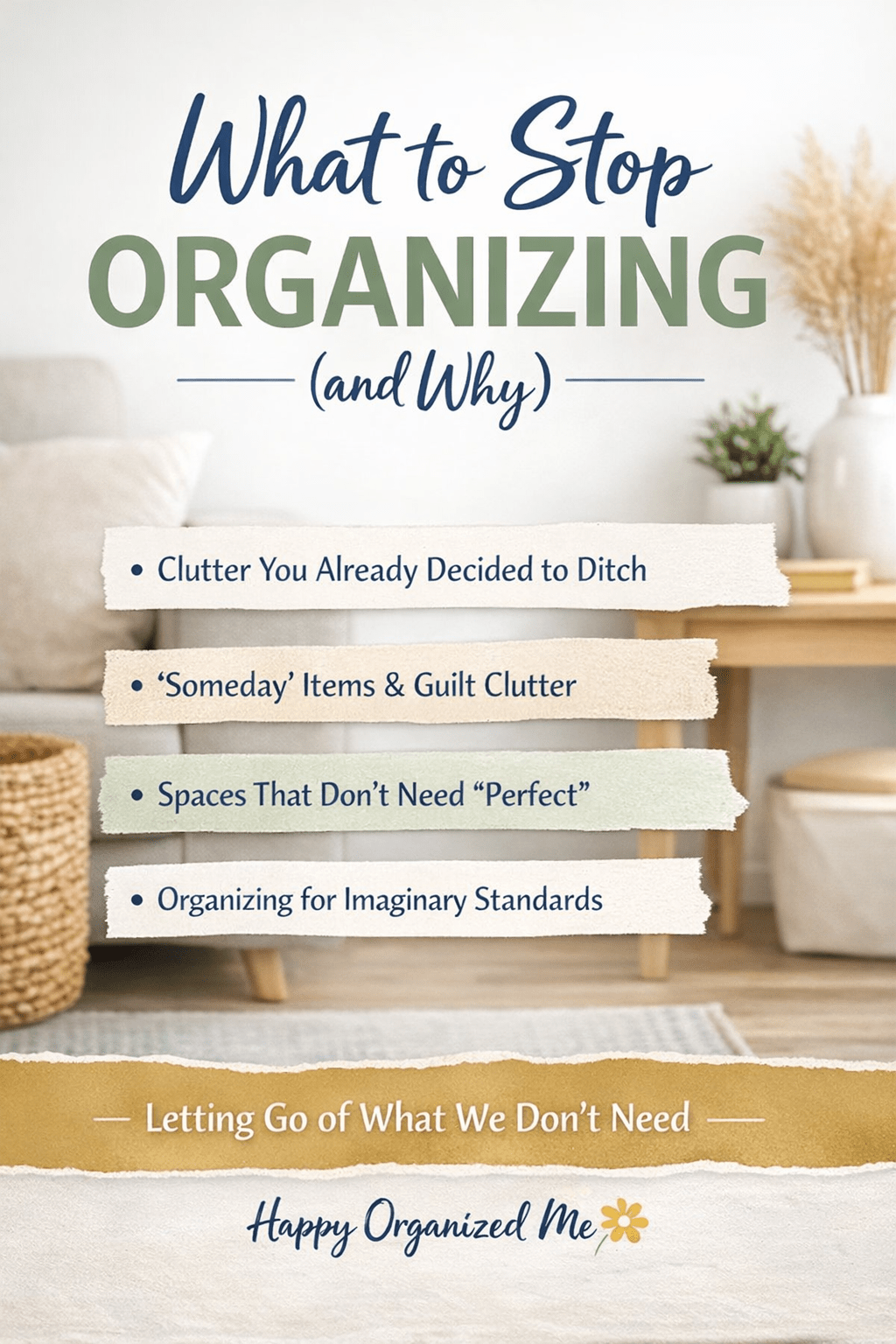
There comes a point when organizing stops being helpful and starts becoming another form of pressure.
Not everything in your home needs a labeled bin.
Not every drawer needs a system.
Not every space needs to be optimized, folded, color-coded, or made beautiful before it can be useful.
Sometimes what we call “getting organized” is actually just rearranging stress.
And if your home has been feeling heavy lately, this may be one of the gentlest shifts you can make:
Stop organizing the things that are not serving your real life.
Because sometimes the answer is not a better container.
Sometimes it is fewer decisions.
Sometimes it is less.
Sometimes it is permission to leave well enough alone.
This is not about giving up.
It is about noticing where your energy is going—and whether it is actually helping your home feel lighter.
Organizing Is Not Always the Solution
There is a big difference between a system that supports you and a system that quietly demands too much from you.
A helpful system makes daily life easier.
A draining system looks nice for a minute but creates more work to maintain.
We have all done this before:
- buying containers for clutter we do not even want
- spending an hour sorting items we rarely use
- trying to perfect a space that is not the real problem
- organizing things we should probably donate, toss, or stop managing altogether
This is where home care can start to feel exhausting.
Because organizing is often praised as the answer to overwhelm—but sometimes it just delays the more honest question:
Do I even need to keep, manage, or improve this at all?
That question can change everything.
Stop Organizing Clutter You Have Already Decided You Don’t Want
If you already know something needs to leave, do not give it a prettier temporary home.
This is one of the most common energy drains in a home.
You gather random extras, duplicate items, old papers, unused decor, broken gadgets, or clothes you no longer wear… and instead of removing them, you sort them. You stack them. You label them. You move them into baskets.
Now the clutter is “organized,” but it is still taking up space, still asking for attention, and still making your home feel full.
You do not need a better way to store what you do not want.
You need permission to stop managing it.
Try this simple filter:
- If it is trash, throw it away.
- If it is donation-worthy, put it in a bag and move it out.
- If it belongs somewhere else, return it.
- If you truly use it and need it, then organize it.
That order matters.
Decluttering first is often what makes organizing finally work.
Stop Organizing “Someday” Items You Keep Out of Guilt
Some items stay in our homes because they represent a version of us we still feel responsible for.
The craft supplies for the hobby you never started.
The serving pieces for the kind of hosting you do not actually enjoy.
The workout equipment that makes you feel bad every time you see it.
The “good intentions” bins full of future projects, repairs, or plans.
These items can create a low-grade emotional weight that has very little to do with physical clutter.
They are not just objects.
They are expectations.
And sometimes the reason organizing them feels so tiring is because your heart already knows they do not belong in your current season.
You are not failing because your life changed.
You are not lazy because your priorities shifted.
You are allowed to release things that matched an old version of you.
Not every item deserves a permanent place in your home just because it once made sense.
Stop Organizing Spaces That Do Not Need to Be High-Function
Not every corner of your home needs to perform like a magazine spread.
Some spaces are allowed to be simple.
Some spaces are allowed to be loose.
Some spaces are allowed to be “good enough.”
This matters because many people try to apply the same level of order to every room, every drawer, and every shelf. But not all spaces need the same level of structure.
Your daily coffee area? That probably needs to work well.
Your entryway? Yes, that needs support.
Your kitchen tools? Definitely worth organizing.
But the back shelf in a guest closet? The extra cabinet in the laundry room? The top of a storage shelf you only touch twice a year?
Those spaces may not need your best energy.
If a space is not causing friction in daily life, you do not need to force a project onto it just because it is not perfect.
Organizing should solve problems.
It should not create them.
Stop Over-Organizing for Imaginary Standards
Sometimes we organize because we want our home to feel better.
Sometimes we organize because we think it should look a certain way.
Those are not the same thing.
If you are trying to make your home look like someone else’s system, you may end up creating routines that do not fit your household at all.
Maybe open bins work better for your family than perfectly folded drawers.
Maybe visible baskets help you more than hidden storage.
Maybe your kids can maintain simple hooks, but not complicated closet zones.
Maybe your kitchen needs “easy and obvious,” not aesthetic and exact.
That is not doing it wrong.
That is organizing for real life.
A system is successful if the people living there can actually use it and keep it going with reasonable effort.
You do not need to organize for appearances.
You need to organize for relief.
Stop Trying to Organize Your Way Out of Being Tired
This one matters more than we often admit.
Sometimes the reason a space is not staying organized is not because you have not found the right system.
Sometimes you are tired.
Sometimes your schedule is full.
Sometimes you are caring for other people.
Sometimes you are in a hard season.
Sometimes your capacity is different than it used to be.
That does not mean you need to try harder.
It means your home may need to ask less of you.
This is where lighter systems matter most:
- fewer decor pieces to dust and manage
- fewer categories to maintain
- fewer steps to put something away
- fewer “shoulds” hanging over every room
- fewer items in circulation altogether
The goal is not to become a person who can keep up with everything.
The goal is to create a home that supports the person you actually are right now.
What to Focus on Instead
If you stop organizing the wrong things, you make room to support the right ones.
Instead of organizing everything, focus on the spaces that affect your daily rhythm most.
Start with:
- surfaces you use every day
- drop zones that collect real-life clutter
- items you reach for constantly
- routines that break down over and over
- spaces that make you feel immediate stress
These are the places where organizing can truly lighten the load.
Ask:
- What do I use often?
- What keeps getting dropped here?
- What makes this room harder than it needs to be?
- What could be simpler?
- What can leave instead of being managed?
That last question is often the most powerful one in the room.
A Gentler Definition of an Organized Home
An organized home is not one where everything looks perfect.
It is one where your home supports your life instead of interrupting it.
It is one where the systems are simple enough to keep going.
It is one where you are not constantly maintaining things you do not value.
It is one where the visual noise is lower, the friction is lower, and the pressure is lower too.
Sometimes the biggest shift is not adding a new system.
It is stopping the unnecessary ones.
Stopping the effort that is not helping.
Stopping the guilt-based projects.
Stopping the endless managing of things that no longer belong.
That is not laziness.
That is wisdom.
And often, that is what makes a home finally feel lighter.
Tiny Win to Try Today
Choose one small area—a drawer, shelf, basket, or corner—and ask:
Am I organizing something here that I do not even want, need, or use?
Then do one of these:
- remove what no longer belongs
- simplify the category
- reduce the steps
- leave the rest alone for now
Less pressure counts.
Less maintenance counts.
Less visual noise counts.
Small shifts still change how a home feels.
CTA
Need a place to start without overthinking it? Grab your Room Reset printables and choose one space to simplify in a way that actually supports real life—not perfection.
Join the conversation—share your tiny wins with me. 💛 Hit reply or drop a comment and tell me one small thing you did today that made your home feel lighter.
Need to go deeper? Read ‘What to Store, Donate, and Toss This Season’.
You’ve got this!

Share your tiny win