Some kitchen clutter is easy to understand.
Expired food? Toss it.
Broken spatula? Let it go.
Three empty takeout containers with no lids? Goodbye.
But then there is the other kind of kitchen clutter.
The kind that comes with guilt.
The extra dishes you never use but feel bad getting rid of.
The kitchen gadget you bought with good intentions.
The serving bowl from a family member.
The appliance that was supposed to make life easier but mostly takes up cabinet space.
The mugs, platters, pans, and specialty tools that sit there quietly saying, “But what if you need me someday?”
This is why kitchens can feel so full even when they are technically organized.
Because sometimes the problem is not the dishes.
It is the guilt attached to them.
Why Kitchen Clutter Feels So Personal
The kitchen is not just a room full of stuff.
It holds memories, money, family traditions, future hopes, and sometimes an imaginary version of ourselves.
We keep things because:
“I spent money on that.”
“That was a gift.”
“I might host more someday.”
“I wanted to become the kind of person who uses that.”
“My mom had one.”
“What if I need it for a holiday?”
“That is still perfectly good.”
None of those thoughts are silly.
They are human.
But here is the truth: just because something is useful does not mean it is useful to you right now.
And just because something was once meaningful does not mean it needs to keep taking up prime space in your kitchen.
The Hidden Cost of Keeping Too Much
When your cabinets are too full, everything takes more effort.
You have to move three things to reach one bowl.
You avoid putting dishes away because the cabinet is packed.
You buy duplicates because you cannot see what you already own.
You feel irritated every time a drawer jams.
You stop using the tools you actually love because they are buried behind tools you feel guilty about.
That is the hidden cost.
The item may be “free” to keep, but it is costing you space, ease, time, and mental energy.
A calm kitchen is not created by keeping every possible thing.
It is created by keeping the things that support the way you really live.
Start With the Question: “Does This Earn Its Space?”
This question is kinder than “Should I get rid of this?”
Because “Should I get rid of this?” can feel harsh.
But “Does this earn its space?” brings the decision back to function.
Ask:
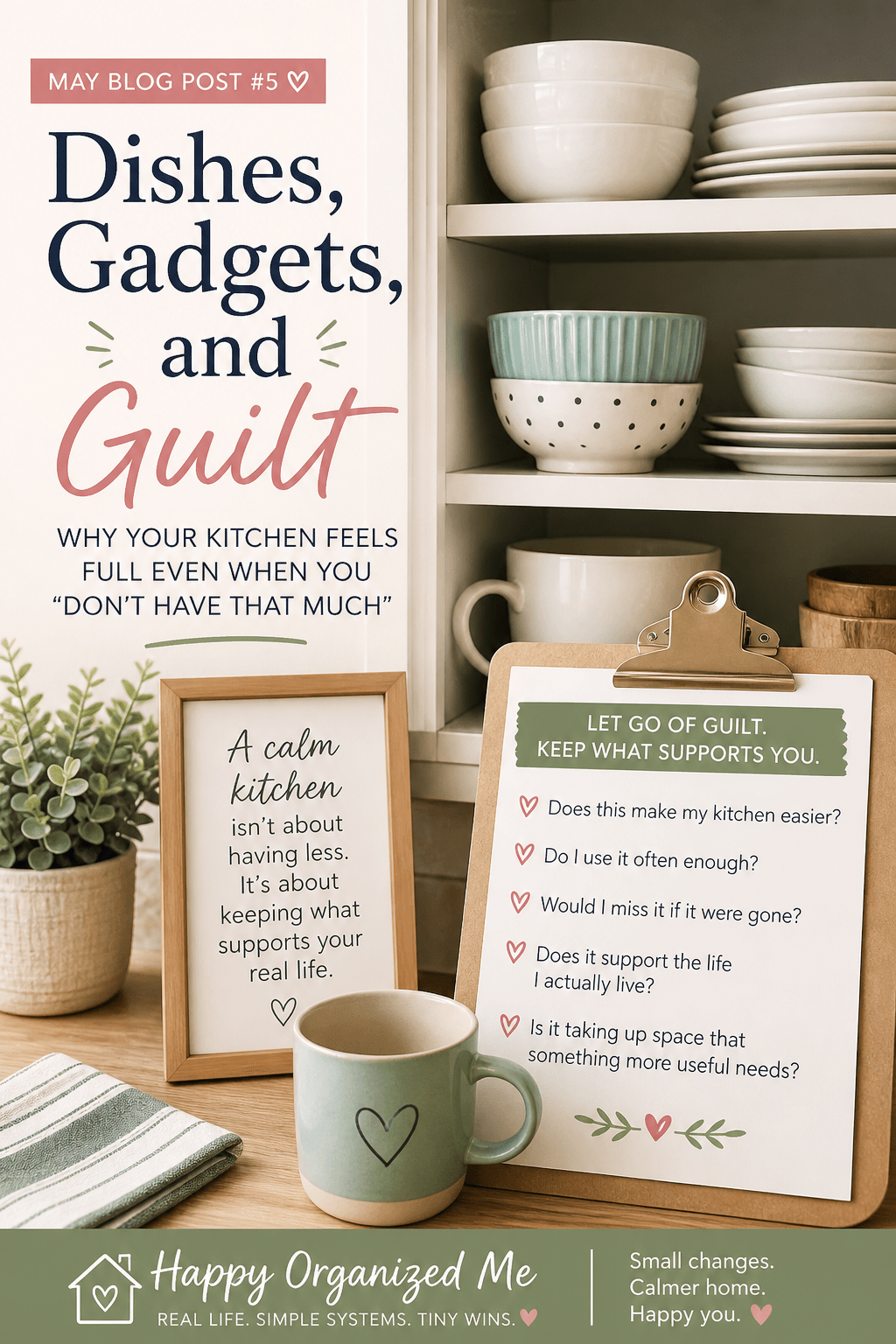
Does this make my kitchen easier?
Do I use it often enough to keep it here?
Would I miss it if it were gone?
Does it support the life I actually live?
Is this taking up space that something more useful needs?
This is not about being wasteful.
It is about being honest.
Your kitchen has limited space. The items you use every day deserve better access than the items you use once every three years.
The “Guilt Categories” Hiding in Your Kitchen
Let’s name the most common ones.
1. The Expensive Mistake
This is the blender, mixer, pan, appliance, or gadget you bought because you thought it would change your life.
Maybe it did not.
Maybe it was annoying to clean.
Maybe it was too big.
Maybe you used it twice and then avoided it.
The money was already spent. Keeping the item does not bring the money back.
But letting it go can give you back space.
Try saying:
“I learned what does not work for me.”
That is not failure. That is information.
2. The Gift You Feel Bad About
Gifts can be tricky because they come wrapped in emotion.
A dish, mug, platter, or gadget may remind you of the person who gave it to you. But the purpose of a gift is not to become a burden.
You are allowed to appreciate the kindness without keeping the object forever.
If the item is not serving your home, you can let it move on.
Try saying:
“The love stays. The item can go.”
That one sentence can soften the decision.
3. The Fantasy Self Item
This is the item connected to the version of you who makes homemade pasta every weekend, hosts brunch for twelve, bakes layered cakes, or juices celery every morning.
There is nothing wrong with that version of you.
But your kitchen needs to support your real life first.
If an item represents a hobby you truly want to try, keep it intentionally.
But if it mostly makes you feel behind, guilty, or disappointed, it may not belong in your everyday kitchen space.
Try saying:
“I can honor who I am becoming without crowding who I am today.”
4. The “Just in Case” Collection
Extra plates. Extra mugs. Extra serving spoons. Extra casserole dishes. Extra pans.
A few backups can be useful.
Too many backups become a storage problem.
Ask yourself:
How many people live here?
How many dishes do we actually use in one day?
How often do we host?
Could we borrow or improvise if needed?
Could holiday-only items live somewhere else?
Your kitchen does not have to hold every possible future event.
It needs to support your normal week.
5. The Family Tradition Item
Some pieces carry history.
Grandma’s serving bowl. A holiday platter. A recipe box. A special pan.
These items may absolutely deserve a place in your home.
But meaningful items should not be shoved into overstuffed cabinets where they become clutter by accident.
If something matters, treat it like it matters.
Give it a specific place.
Use it.
Display it.
Store it safely.
But do not let every inherited or sentimental item automatically claim your daily kitchen space.
A Gentle Way to Sort Without Feeling Overwhelmed
Do not empty every cabinet at once unless you have the time and energy to finish.
Instead, choose one small category.
Start with one of these:
- Mugs
- Water bottles
- Spatulas
- Serving bowls
- Baking pans
- Storage containers
- Small appliances
- Gadgets
- Extra plates
- Holiday dishes
Pull out only that category.
Then sort into four simple groups:
Keep in the kitchen: Items you use often and want easy access to.
Store elsewhere: Items you use seasonally or only for holidays.
Donate or share: Items that are useful but not useful to you.
Let go: Broken, chipped, missing pieces, or items you would not choose again.
This keeps the project contained.
You are not “decluttering the whole kitchen.”
You are just making one category easier to use.
That is a tiny win.
Give Your Everyday Items the Best Space
One of the biggest kitchen mistakes is giving prime cabinet space to rarely used items.
Prime space means:
Eye-level shelves
Easy-to-reach drawers
Front cabinet areas
The most convenient spots near the dishwasher, stove, sink, or prep zone
These spaces should belong to your daily life.
Your everyday plates should be easy to put away.
Your favorite pan should be easy to grab.
Your daily coffee mugs should not be crowded by fifteen extras.
Your most-used gadgets should not be buried behind the “maybe someday” tools.
When your everyday items are easy to reach, the whole kitchen feels calmer.
What About Things You Truly Aren’t Ready to Let Go?
That is okay.
You do not have to force it.
Create a “not ready yet” box.
Put the questionable items inside and move the box out of your daily kitchen space. Label it with the date.
Then give yourself a time frame.
Thirty days.
Ninety days.
Six months.
If you need something from the box, go get it.
If you never open the box, that tells you something.
This method gives your brain a little breathing room. You are not making a dramatic decision. You are testing whether the item still belongs in your life.
Tiny Win: The 10-Minute Gadget Check
Choose one drawer, bin, or cabinet section with gadgets.
Set a timer for 10 minutes.
Pull out the tools and ask:
Do I use this?
Do I like using this?
Is it easy to clean?
Do I already own something else that does the same job?
Would I buy this again today?
Keep the clear yes items.
Move the unsure items to a small “test it or let it go” spot.
Let go of anything broken, annoying, duplicated, or never used.
In 10 minutes, you can make one drawer feel lighter.
That counts.
What Done Looks Like
Your kitchen does not need to look empty.
It needs to feel usable.
You are done when:
- The dishes you use most are easy to reach
- Cabinets close without a wrestling match
- Drawers open smoothly
- You know what you own
- You have fewer duplicate tools
- Seasonal items are not crowding daily items
- Guilt is no longer making every decision
- Your kitchen supports your real life
That is the goal.
Not a perfect kitchen.
A supportive one.
Final Thought
Letting go of kitchen items does not mean you are ungrateful.
It does not mean you wasted money.
It does not mean you are giving up on who you wanted to become.
It means you are choosing to respect the space you live in now.
Your kitchen should not be a storage unit for guilt.
It should be a room that helps you feed yourself, care for your family, and move through the day with a little more ease.
Start small.
One drawer.
One shelf.
One gadget.
One tiny decision that makes your kitchen feel lighter.
That is enough.
Join the conversation—share your tiny wins with me. 💛 Hit reply or drop a comment and tell me one small thing you did today that made your home feel lighter.

Share your tiny win