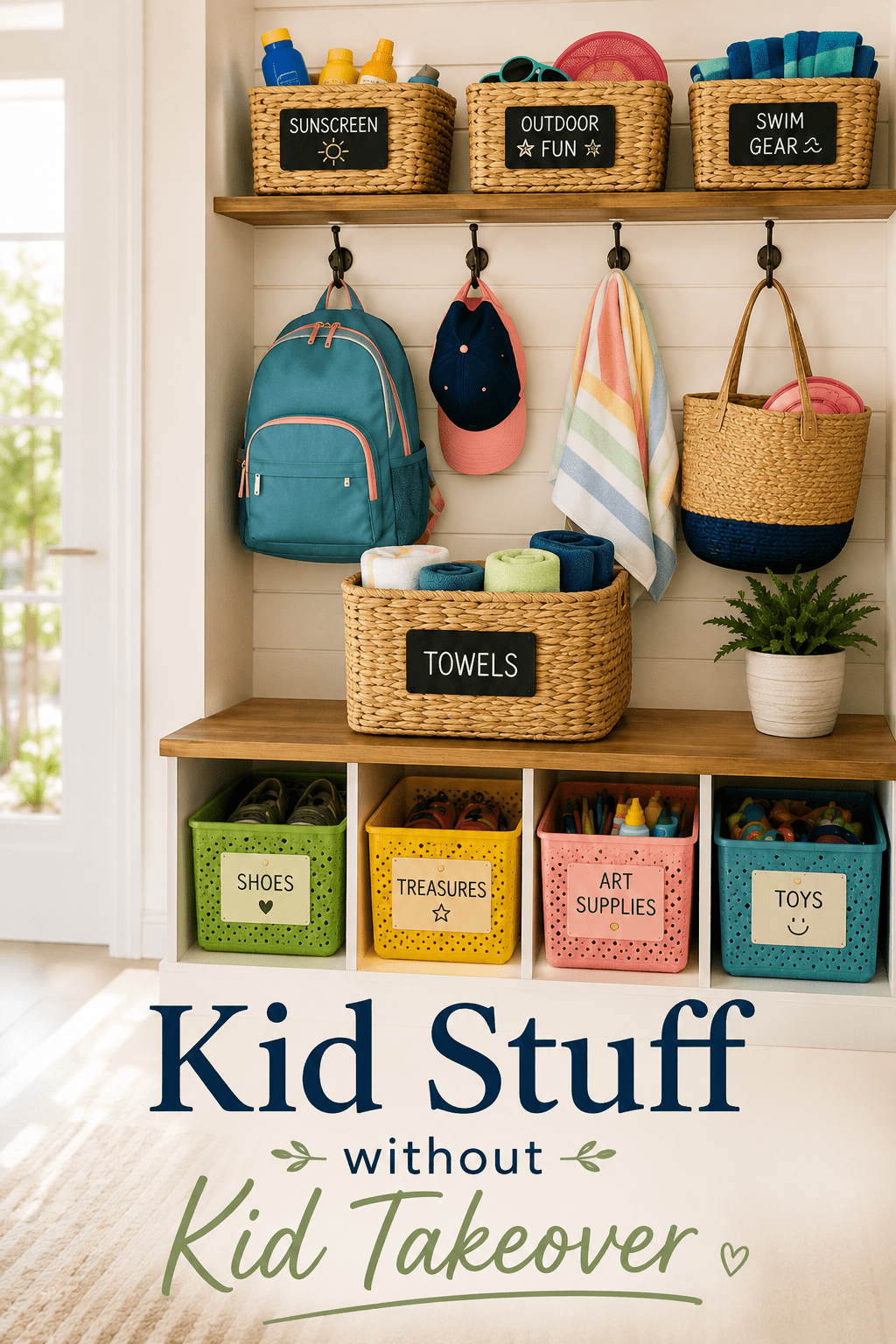
- Kids come with stuff
- Shoes
- Backpacks
- Crafts
- Toys
- Snacks
- Books
- Sports gear
- Tiny treasures
- Random rocks
- Half-finished projects
- Water bottles
- Blankets
- Art supplies
- Stuffed animals
And all the mysterious little things they insist are “important.”
During summer, kid stuff can spread even faster.
There are fewer school-day routines, more time at home, more outdoor play, more snacks, more activities, and more “I’ll put it away later” moments.
Before long, the kitchen table has markers on it, the living room has toys in it, the entryway has shoes everywhere, and the house starts to feel like the kids have taken over every surface.
But here is the good news:
You do not have to choose between a home that feels good to you and a home where kids are allowed to live, play, create, and be themselves.
You just need simple boundaries.
Not harsh boundaries.
Not perfect systems.
Just clear homes for the things that keep landing everywhere.
Because the goal is not to erase kid life from your home.
The goal is to give kid life a place to land.
Why Kid Stuff Takes Over So Quickly
Kid clutter often spreads for three reasons.
First, kids use things in motion. They are not always thinking about where something belongs. They are moving from one idea to the next.
Second, many homes do not have clear kid-friendly zones. If the system is too high, too hidden, too complicated, or too far away, kids are less likely to use it.
Third, summer loosens the routine. That can be wonderful, but it also means there are fewer natural reset points built into the day.
So if your house feels taken over, it does not mean your kids are bad at cleaning.
It may mean the system is asking too much of them.
A better question is:
Can they put this away without my help?
If the answer is no, the system probably needs to be simpler.
Start With the Main Landing Spots
Before you buy bins or reorganize everything, notice where kid stuff naturally lands.
Look around and ask:
Where do shoes pile up?
Where do toys spread out?
Where do art supplies end up?
Where do backpacks or bags land?
Where do snacks get opened?
Where do outdoor items come inside?
Where do tiny treasures collect?
Those landing spots are not failures.
They are clues.
They show you where your home needs a simple system.
If shoes always land by the back door, create a shoe basket there.
If toys always end up in the living room, create a small living room toy bin.
If craft supplies keep landing on the dining table, create a craft caddy nearby.
Work with the pattern instead of fighting it.
That is how systems stick.
Create Kid Zones, Not Kid Takeover
A kid zone is a clear place where certain kid items belong.
It does not have to be a whole room.
It can be one basket, one drawer, one shelf, one cabinet, one hook, or one corner.
Helpful kid zones might include:
- A shoe basket near the door
- A backpack hook
- A summer activity bin
- A living room toy basket
- A craft caddy
- A snack drawer
- A water bottle spot
- A library book basket
- A sports gear bin
- A “treasure box” for little collections
The key is to keep each zone specific.
A basket labeled “kid stuff” will become a black hole.
A basket labeled “outdoor toys” works better.
A drawer labeled “craft supplies” works better.
A bin labeled “library books” works better.
The more specific the home, the easier it is for kids to return things.
Use the “Can They Reach It?” Test
If you want kids to help maintain a system, they need to be able to reach it.
This sounds obvious, but it is one of the most common reasons kid organization breaks down.
If the hooks are too high, jackets land on the floor.
If the bins are too heavy, toys stay out.
If the lids are tricky, supplies do not get put away.
If the labels are confusing, everything gets mixed together.
A kid-friendly system should be:
- Low enough to reach
- Easy to open
- Easy to understand
- Easy to repeat
- Simple enough to use when tired
For younger kids, picture labels can help.
For older kids, simple word labels are usually enough.
The system does not need to be cute.
It needs to be usable.
Limit the “Out at One Time” Amount
One reason kid stuff feels overwhelming is that too much is available at once.
When every toy, game, craft, and activity is accessible all the time, cleanup becomes a huge job.
Try limiting what is out at one time.
You can do this by creating:
- One active toy basket
- One current craft bin
- One puzzle/game shelf
- One outdoor play bin
- One rotating activity basket
Store the extras somewhere else and rotate them when needed.
This does not mean taking everything away.
It means reducing the amount that can explode across the house at one time.
Kids often play better with fewer choices.
And cleanup becomes much more realistic.
Give Tiny Treasures a Home
Kids collect things.
Rocks.
Shells.
Stickers.
Notes.
Birthday party prizes.
Tiny plastic toys.
Coins.
Feathers.
Beads.
Bracelets.
Things from the ground that somehow feel emotionally important.
Instead of arguing over every little item, create a small treasure box.
Each child gets one container for tiny treasures.
The rule is simple:
If it matters to you, it can go in your treasure box.
When the box is full, it is time to sort.
This gives kids ownership while still creating a boundary.
It also keeps little bits from spreading across counters, drawers, nightstands, and the washing machine.
Make Cleanup Short and Predictable
Kids usually do better with short cleanup rhythms than big dramatic cleaning sessions.
Instead of waiting until the whole house is a disaster, build in small resets.
Try:
Morning reset: Pajamas, breakfast dishes, and beds.
Before lunch reset: Toys back to bins.
Before dinner reset: Main living spaces cleared.
Before bed reset: Shoes, water bottles, and personal items returned.
Keep the reset short.
Five minutes can make a big difference.
You can say:
“Let’s do a five-minute pickup.”
Or:
“Everything goes back to its home before we start the next thing.”
The goal is not to create perfect little cleaners.
The goal is to teach a rhythm of returning things.
That skill matters.
Use Baskets as Boundaries
Baskets are helpful because they create a visible limit.
The basket says:
This is how much space this category gets.
If the basket is overflowing, it is time to sort.
This works well for:
- Stuffed animals
- Toy cars
- Dolls
- Dress-up clothes
- Balls
- Building toys
- Outdoor toys
- Art supplies
- Summer gear
The basket is not just storage.
It is a boundary.
And boundaries make the home feel calmer.
Protect a Few Adult Spaces
This is important.
A family home should support everyone who lives there.
That includes the adults.
It is okay to have a few spaces that are not kid zones.
Maybe that is your bedroom.
Your nightstand.
The kitchen island.
The dining table after dinner.
Your office.
A favorite chair.
A clean entry surface.
The coffee table after evening reset.
You are not being selfish by protecting a few calm spaces.
You are showing that everyone’s needs matter.
Kids need room to play and create.
Adults need room to breathe and function.
Both can be true.
Teach “Reset,” Not “Clean Your Mess”
The words we use matter.
“Clean your mess” can feel vague and overwhelming.
“Reset the room” feels more specific.
A reset means:
- Put toys back in the basket
- Return shoes to the door spot
- Put cups in the sink
- Throw trash away
- Put art supplies back in the caddy
- Straighten pillows or blankets
A reset is not punishment.
It is returning the space to usable.
That is a life skill.
When kids understand that resetting helps the home work for everyone, it becomes less about shame and more about responsibility.
Tiny Win: The 15-Minute Kid Stuff Reset
Choose one area where kid stuff keeps taking over.
Set a timer for 15 minutes.
Minutes 1–3: Gather
Collect the kid items from that area into one pile or basket.
Minutes 4–7: Sort
Group items into simple categories: toys, books, crafts, shoes, treasures, trash, dishes.
Minutes 8–11: Create one home
Choose a bin, basket, shelf, hook, or drawer for the category that causes the most trouble.
Minutes 12–15: Teach the rule
Tell your kids the new rule in one sentence.
Examples:
“Outdoor toys go in this basket.”
“Library books live here.”
“Shoes go in this bin.”
“Crafts go back in this caddy.”
That is enough for today.
One clear home can reduce a lot of daily friction.
What Done Looks Like
Your kid systems are working when:
- kids know where common items go
- cleanup feels shorter and more realistic
- toys are not taking over every room
- summer gear has a clear place to land
- snacks, water bottles, and shoes are easier to manage
- tiny treasures have a boundary
- adult spaces feel a little more protected
- the home still feels lived in, but not completely overrun
Done does not mean there are no kid items visible.
Done means kid items have homes they can return to.
That is the difference.
Read Next
Summer Organization for Real Life Chaos
If summer has already brought more snacks, towels, water bottles, sunscreen, and activity gear into your home, this article is a perfect next step. It walks through simple seasonal systems that help your home handle the busy, messy, real-life rhythm of summer.
Join the Tiny Wins Club Newsletter
Want more simple home systems that work for real families?
Join the Tiny Wins Club Newsletter for gentle organizing ideas, seasonal resets, printable guides, and small steps that help your home feel lighter without chasing perfection.
It is not about doing everything.
It is about finding one tiny win that makes today easier.
Final Thought
Kid stuff does not have to take over the whole house.
And your home does not have to look untouched to feel organized.
The goal is to create simple places for kid life to land.
A basket by the door.
A craft caddy near the table.
A treasure box for tiny finds.
A toy bin in the living room.
A five-minute reset before bed.
Small systems teach kids where things belong and give your home a little more breathing room.
You are not trying to remove the evidence of childhood.
You are creating a home where childhood and calm can live together.
Real life. Simple systems. Tiny wins.
Join the conversation—share your tiny wins with me. 💛 Hit reply or drop a comment and tell me one small thing you did today that made your home feel lighter.

Share your tiny win