The holidays can feel full before they even begin.
A few dates go on the calendar.
A gift idea pops into your head.
A school event gets announced.
Someone asks about dinner plans.
A package arrives.
A recipe gets saved.
A guest might be coming.
A budget thought starts tugging at you.
You remember wrapping paper.
You remember travel.
You remember cards.
You remember that the pantry, the house, and your energy all seem to matter too.
And suddenly, the season is not just a season.
It is a hundred small moving pieces asking to be remembered at the same time.
That is where stress often begins.
Not because you are doing it wrong.
Because the holidays ask for a lot of decisions.
A calm holiday planning system is not about doing more.
It is about giving all those moving pieces a place to land.
One place for dates.
One place for gift ideas.
One place for meal thoughts.
One place for lists.
One place for what needs to be done next.
Not perfect.
Just clearer.
Because when the season stops living only in your head, it gets a little easier to carry.
Why Holiday Planning Feels So Heavy
Holiday stress is often decision stress.
What needs to happen?
When does it need to happen?
What can wait?
What have I already bought?
What do I still need?
What are we doing for meals?
What is the budget?
Who is coming?
What events matter most?
What is realistic this year?
When there is no clear planning system, every thought feels urgent.
Everything stays mentally open.
That makes the season feel louder than it needs to.
A calm planning system does not remove every task.
But it helps separate:
- what matters now
- what matters later
- what is already handled
- what can be simplified
- what does not need your energy this year
That kind of clarity can change the entire feeling of the season.
Calm Starts With One Holiday Home
The first step is simple:
Create one holiday home.
This is one place where your holiday planning lives.
Not scattered across random papers, text messages, sticky notes, your purse, the kitchen counter, and the back of your mind.
Your holiday home could be:
- one notebook
- one binder
- one folder
- one clipboard
- one basket
- one planner section
- one digital note if that truly works better for you
The tool itself matters less than the consistency.
The question is:
Where do I look first?
If your answer is not clear, the system is not calm yet.
A calm holiday planning system begins when the season has one main place to land.
Keep the System Simple Enough to Use
A planning system is only helpful if you will return to it.
That means simpler is often better.
You do not need a complicated binder with dozens of sections unless that genuinely helps you.
Most people do well with a handful of core categories.
For example:
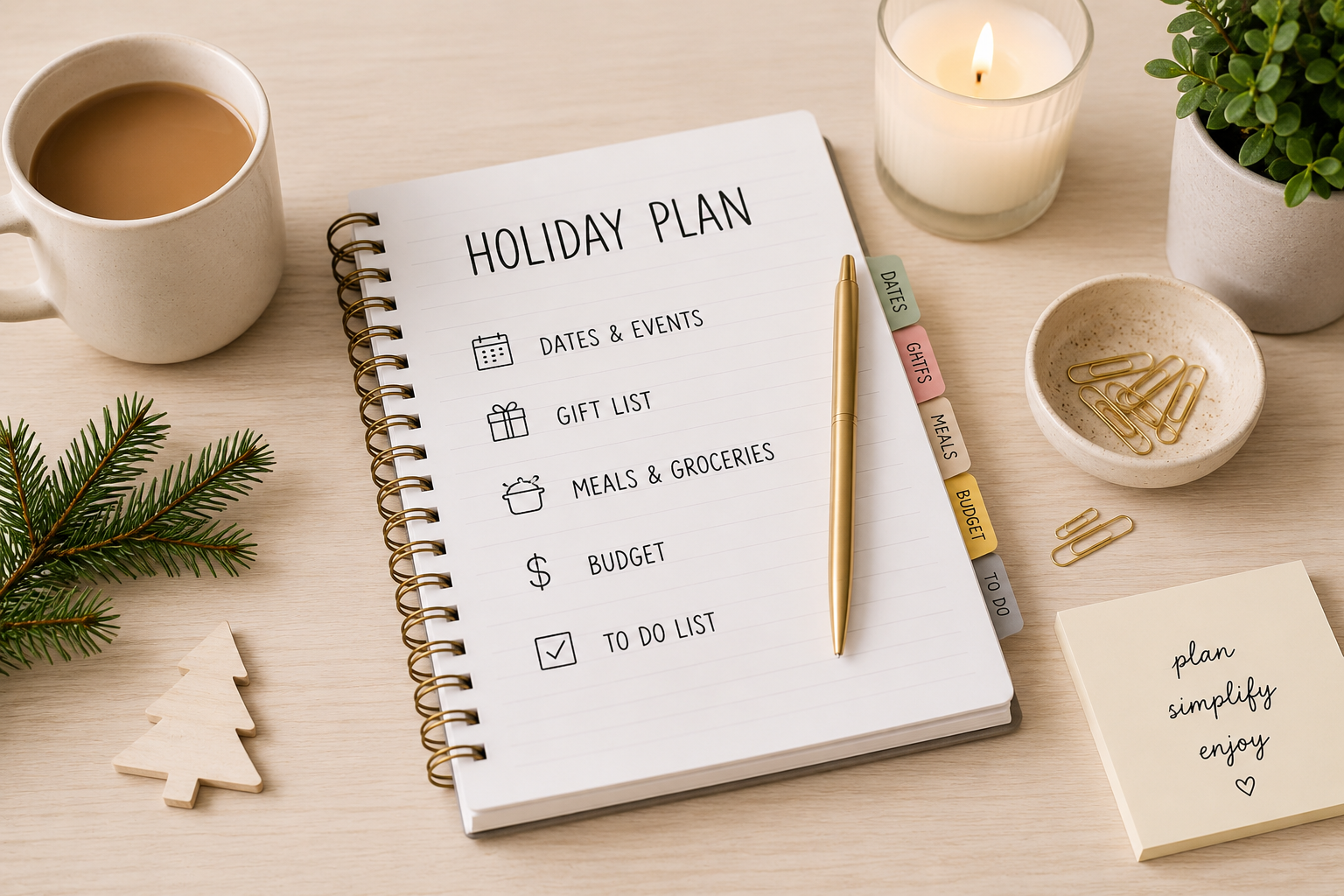
- calendar
- gift list
- meals and groceries
- hosting or guest notes
- budget
- to-do list
- traditions or seasonal ideas
That is enough.
If the system becomes too detailed, it can turn into another project.
The purpose is not to build the perfect planner.
The purpose is to make the holidays easier to think through.
Start With the Calendar First
A calm holiday planning system should begin with dates.
If the dates are unclear, everything else feels blurry.
Write down:
- school events
- family gatherings
- travel dates
- church or community events
- work parties
- performances
- appointments
- hosting dates
- deadlines for shipping or ordering
- traditions you want to keep
- days you want to leave open
This helps you see the shape of the season.
It also helps you avoid overcommitting before you realize how full the month already is.
A calm calendar is not about filling every square.
It is about knowing what is real.
When you can see the season, you can make better choices inside it.
Make One Running Gift List
Gift stress grows quickly when gift ideas live everywhere.
A text here.
A sticky note there.
A screenshot somewhere.
A mental note you hope you remember later.
Create one running gift list.
Keep it simple.
Include:
- names
- gift ideas
- what has been purchased
- what still needs to be bought
- what needs to be wrapped
- what needs to be mailed
- a budget note if helpful
That is enough to bring clarity.
A running gift list reduces duplicate buying, forgotten gifts, and last-minute scrambling.
It also helps you stop carrying every gift thought in your head all day.
Give Holiday Meals Their Own Space
Holiday meal stress often starts early.
What are we making?
What do we need?
What is for the actual holiday?
What is for gatherings before that?
What easy meals do we need during the busier weeks?
What baking matters this year?
What can stay simple?
Create one meal section.
This can include:
- important holiday meals
- favorite recipes
- grocery needs
- baking plans
- potluck contributions
- freezer or make-ahead ideas
- simple weeknight meals for busy weeks
This matters because the holidays are not only about one big meal.
They are also about the regular days around it.
A calm planning system leaves room for both special meals and ordinary support.
Keep a Small Holiday To-Do List — Not a Giant One
A long holiday to-do list can make the whole season feel impossible.
Instead of one giant list, keep your tasks in smaller layers.
Try:
This Week
What truly needs attention this week?
Soon
What matters later but not right now?
Waiting
What is pending, ordered, or waiting on someone else?
This makes the list feel calmer because not everything is demanding your attention at once.
A system that shows priority is kinder than a system that just shows volume.
You do not need to stare at everything every day.
You only need to see the next things clearly.
Give the Budget a Gentle Place to Live
Money stress can make the holidays feel heavy fast.
A calm system does not ignore that.
It gives money a place to be seen honestly.
You do not need a complex spreadsheet unless you want one.
You may only need one page or one note with:
- gift budget
- food budget
- travel budget
- decor or seasonal spending
- donations
- events or extras
The goal is not perfection.
The goal is awareness.
When spending stays vague, stress grows.
When spending has a place to live, the season feels more grounded.
A calm budget is not about doing more.
It is about reducing surprise.
Create One Holiday Paper Path
Holiday paper can multiply quickly.
Cards.
Receipts.
Invitations.
School event reminders.
Shopping lists.
Recipes.
Coupons.
Printed travel notes.
Gift tags.
Mailing information.
Without a paper path, those things end up all over the house.
Create one place for holiday paper.
That could be:
- one folder
- one tray
- one section in your command center
- one pouch in your planner
- one clipped stack on a clipboard
The purpose is simple:
Holiday paper goes here first.
That one rule can reduce a lot of visual and mental clutter.
Use Weekly Check-Ins Instead of Daily Pressure
Holiday planning does not have to become a daily mental burden.
A better rhythm is often one short weekly check-in.
Once a week, sit down for 10–15 minutes and ask:
What is coming up this week?
What needs attention now?
What did I already finish?
What can be crossed off?
What can be simplified?
What am I forgetting?
What feels heavier than it needs to?
This keeps the system alive without letting it take over your days.
A calm planning system should support your life.
It should not become a second full-time job.
Add a “Not This Year” List
This can be one of the most calming parts of the whole system.
Write down what you are not doing this year.
Maybe it is:
- elaborate baking
- decorating every room
- handmade gifts
- too many events in one weekend
- hosting everyone
- sending cards to every possible person
- keeping up with traditions that no longer fit
- overspending
- doing everything yourself
A Not This Year list creates boundaries.
It reminds you that calm is not only about what you plan to do.
It is also about what you choose not to carry.
That is not giving up.
That is protecting the season.
Plan Around What Matters Most
A calm holiday planning system should help you see what matters most.
Not what social media says should matter.
Not what you used to do in a completely different season of life.
Not what looks impressive.
Ask:
What do I want this season to feel like?
What traditions really matter to us?
What kind of pace do I want?
What do I want to protect?
What could be simpler?
What would make the season feel meaningful without making it feel heavy?
Your planning system should serve those answers.
Not pull you away from them.
Keep the Supplies Together
Planning feels calmer when the support items are easy to find.
Keep a few basics near your holiday planning home if you can:
- pen
- notepad or notebook
- calendar
- gift list
- receipts
- envelopes or stamps if needed
- tape or labels for gift notes
- a folder for loose paper
This is a small detail, but it matters.
When every planning session starts with searching for supplies, the system becomes harder to use.
Ease supports follow-through.
Let the System Hold What Your Brain Shouldn’t Have To
This is one of the most important mindset shifts.
Your brain does not need to hold every reminder.
That is the job of the system.
Let the system remember:
- dates
- gift ideas
- shopping notes
- meal plans
- supplies you need
- things to mail
- what is already finished
- what is still waiting
The more the system holds, the less your nervous system has to.
That is one reason planning can feel so calming.
It is not just about productivity.
It is about relief.
The 20-Minute Calm Holiday Planning Reset
Set a timer for 20 minutes.
Minutes 1–4: Choose your holiday home
Pick one notebook, folder, clipboard, planner page, or basket.
Minutes 5–8: Write down your known dates
Gather the school events, gatherings, appointments, hosting dates, and important deadlines.
Minutes 9–12: Start one running gift list
Write down names, ideas, and anything already purchased.
Minutes 13–16: Create a this week list
Only the next small steps that actually matter now.
Minutes 17–20: Add one calming boundary
Start a Not This Year list, a budget note, or one paper folder.
Then stop.
You do not need the whole season planned.
You only need the season to stop floating everywhere.
What Done Looks Like
A calm holiday planning system is working when:
- the season has one main planning home
- dates are easier to see
- gift ideas are not scattered everywhere
- holiday meals have a place to live
- paper has a path
- the budget feels more visible
- your to-do list feels prioritized, not endless
- weekly check-ins help you stay grounded
- you know what you are not doing this year
- the season feels more held and less chaotic
Done does not mean every detail is finished.
Done means your planning system is carrying some of the weight with you.
That is enough.
Keep Exploring: Prepare Without Pressure
If this post helped, these related posts can support your holiday season:
Holiday Prep Without Overwhelm
A helpful starting point if your home and routines need support before the season gets fuller.
Kitchen Prep for Hosting Season
Perfect if the kitchen is one of the spaces most likely to feel pressured during gatherings and holiday meals.
Decluttering Before Decorating
Helpful if your seasonal decor is coming out soon and you want the house to feel lighter first.
Preparing Your Home for Busy Months
A good next read if you want to support the spaces that carry more during fuller seasons.
Calm Storage Zones
Useful if papers, gift supplies, seasonal bins, and holiday extras need calmer, clearer homes.
Choose the post that matches the part of the season that feels loudest right now.
Try This Before You Leave
Choose one calm holiday planning tiny win:
- Start one holiday notebook.
- Write down your known dates.
- Create one running gift list.
- Make one simple meal page.
- Start one holiday paper folder.
- Create a This Week list.
- Write a Not This Year list.
- Set one budget note.
- Schedule one weekly planning check-in.
- Stop trying to remember everything in your head.
One small planning system can make the whole season feel lighter.
Join the Tiny Wins Club Newsletter
Want more simple seasonal systems like this?
Join the Tiny Wins Club Newsletter for free organizing ideas, seasonal resets, blog updates, and tiny steps that help your home feel lighter without turning the holidays into a pressure season.
The free version is a simple way to stay encouraged and keep building small habits.
For readers who want more structure, the paid version includes deeper support such as printable guides, extended reset plans, step-by-step worksheets, seasonal checklists, and more detailed HOMe systems you can work through at your own pace.
Start with the free version if you want encouragement and ideas.
Upgrade to the paid version when you want the printables, deeper guides, and extra tools to help you follow through.
The holidays do not need to live entirely in your head.
They need a calm place to land.
Final Thought
A calm holiday planning system is not about controlling every part of the season.
It is about holding the season more gently.
One place for dates.
One place for gift ideas.
One place for meal notes.
One place for paper.
One list for this week.
One honest look at what matters most.
One reminder that not everything needs to be done this year.
That is enough to begin.
The holidays can still be full.
But they do not have to feel scattered.
Real life. Simple systems. Tiny wins.
Join the conversation—share your tiny wins with me. 💛 Hit reply or drop a comment and tell me one small thing you did today that made your home feel lighter.
Leave a Reply