Storage is supposed to help.
But sometimes storage becomes the place where decisions go to disappear.
A bin in the closet.
A basket in the laundry room.
A tote in the garage.
A shelf in the basement.
A cabinet stuffed with things you might need someday.
A drawer that closes only if you push it just right.
At first, it feels like the problem is solved because the items are no longer out in the open.
But if the storage is hard to use, hard to reach, hard to remember, or full of things that no longer fit your life, it is not really supporting you.
It is just hiding clutter.
Good storage is not about having more containers.
It is about creating homes for the things you actually use, need, love, and return to.
Storage that supports your life makes daily routines easier, seasonal transitions smoother, and busy months less overwhelming.
And as the holidays get closer, supportive storage matters even more.
Because more will be coming in.
So before you buy another bin, basket, shelf, or tote, pause and ask:
Is my storage helping me live better, or is it just holding things I do not want to deal with?
That question changes everything.
Storage Is Not the Same as Organization
Storage and organization are related, but they are not the same.
Storage means something has a place to go.
Organization means you can find it, use it, return it, and understand why it is there.
A closet full of bins may look organized, but if no one knows what is inside, it is not supportive.
A garage shelf may hold a lot, but if the things you need most are buried behind boxes from five years ago, it is not helping.
A basket may look pretty, but if it holds random items with no purpose, it is just a softer-looking pile.
Supportive storage has a job.
It answers:
What belongs here?
Who uses it?
How often do we need it?
Is it easy to reach?
Is it easy to put back?
Does this location make sense?
Is this still supporting our current life?
If storage does not answer those questions, it may need a reset.
Start With Your Real Life, Not the Container
It is easy to start with the storage product.
The basket.
The bin.
The shelf.
The drawer organizer.
The matching containers.
The pretty labels.
But the best storage starts with your real life.
Before choosing a container, ask:
What happens in this space?
What do we reach for every day?
What keeps getting left out?
What do we forget we own?
What is hard to put away?
What is coming into this home soon?
What season are we preparing for?
Storage should match the life you are actually living.
Not the life you saw in a photo.
Not the life you think you should have.
Not the life where everyone puts everything away perfectly every time.
Real storage works when people are busy, tired, carrying groceries, running late, making dinner, hosting guests, doing laundry, leaving for school, or trying to reset quickly.
If the system only works on a perfect day, it will not last.
The Best Storage Is Easy to Return To
A storage system is only as good as your ability to put things back.
That is where many systems break.
It is not that people cannot find the item.
It is that putting the item away takes too many steps.
Open the closet.
Move the basket.
Lift the lid.
Pull out another bin.
Make everything fit perfectly.
Close it all again.
That may work for rarely used items.
But it does not work for daily life.
Daily storage should be easy.
Think:
- open baskets
- clear bins
- low hooks
- shallow trays
- labeled drawers
- simple shelves
- easy-to-reach zones
- one-step put away
If something is used every day, it should not require a five-step storage process.
The more often you use it, the easier the storage should be.
Store by How Often You Use It
One of the simplest storage rules is this:
Daily items deserve the easiest spaces.
That means prime storage should go to what you use most.
Keep daily items:
- at eye level
- near where they are used
- easy to grab
- easy to return
- in simple containers
- visible when possible
Occasional items can live a little farther away.
Seasonal items can go higher, lower, deeper, or farther from the main flow of daily life.
Rarely used items do not need prime real estate.
This one shift can make your home feel more functional quickly.
When the things you use most are easiest to reach, the whole day feels smoother.
Stop Using Prime Space for “Someday” Items
Prime space is the easiest, most accessible storage in your home.
That might be:
- kitchen counters
- top drawers
- entryway hooks
- pantry shelves at eye level
- bathroom counter space
- the front of closets
- the laundry room shelf
- the garage shelf closest to the door
These spaces should support your current life.
Not someday.
Not guilt.
Not “maybe.”
Not things you keep because you do not know where else to put them.
Ask:
Is this item earning prime space?
Do I use it often?
Does it support this season?
Would I look for it here?
Is it making daily life easier?
If the answer is no, it may need to move, be stored elsewhere, or leave your home completely.
Your easiest spaces should hold your most useful things.
That is how storage begins to support you.
Create Storage by Zone
Supportive storage is usually built around zones.
A zone is a group of items that support the same activity.
For example:
Entry Zone
Shoes, keys, bags, jackets, sunglasses, going-out items.
Kitchen Prep Zone
Cutting boards, knives, mixing bowls, measuring cups, daily tools.
Lunch Zone
Lunch boxes, containers, snacks, napkins, water bottles.
Cleaning Zone
Spray, cloths, gloves, scrub brush, trash bags, baking soda, vinegar.
Laundry Zone
Detergent, stain remover, baskets, donation bag, dryer sheets or wool balls.
Gift Wrap Zone
Gift bags, tissue paper, tags, tape, scissors, ribbon.
Guest Zone
Towels, sheets, toiletries, extra blanket, charger, tissues.
When items that work together live together, your home becomes easier to use.
You stop hunting.
You stop rebuilding the same task from different rooms.
You let the storage support the activity.
Seasonal Storage Should Be Easy to Rotate
September is a good time to look at seasonal storage.
Summer items may still be out.
Fall items may be coming in.
Holiday items are not far behind.
Seasonal storage works best when it can rotate.
That might mean:
- summer towels move to a higher shelf
- fall jackets move closer to the entry
- sunscreen moves out of prime space
- school and work supplies move forward
- holiday wrap gets checked before buying more
- guest linens move where they are easier to reach
- outdoor items are cleaned before storing
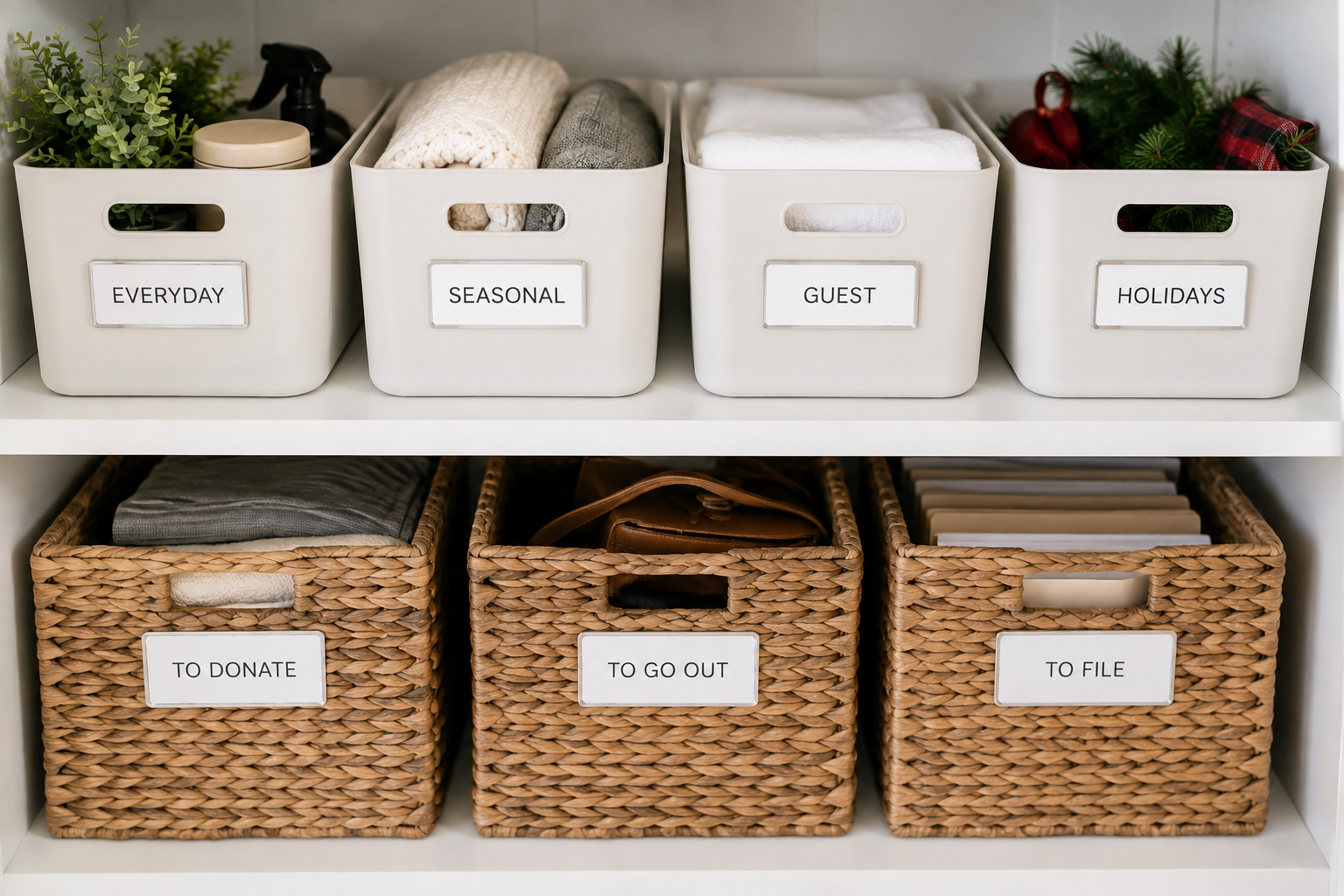
- seasonal bins are labeled clearly
The goal is not to pack your life away.
The goal is to make the next season easier to access.
A seasonal rotation can be small.
One shelf.
One bin.
One closet section.
One basket by the door.
That is enough to begin.
Labels Help Storage Speak
Labels are not just for looks.
They help storage speak.
A label tells everyone:
This belongs here.
This does not belong here.
Put this back here.
Look here first.
Labels reduce repeated decisions.
They also make it easier for other people in the home to use the system without asking you.
Good labels are simple.
Try:
- Shoes
- Keys
- Papers
- Snacks
- Towels
- Cleaning
- Batteries
- Gift Wrap
- Guest Towels
- Use First
- Going Out
- Donations
- This Week
You do not need to label everything.
Start by labeling the spots that get mixed up most often.
A label is a tiny boundary.
And boundaries make storage easier to maintain.
Clear Bins vs. Hidden Storage
Both clear bins and hidden storage have a place.
Clear bins are helpful when you need to see what you have.
They work well for:
- pantry items
- craft supplies
- kids’ items
- garage supplies
- seasonal pieces
- medicine backups
- small categories
- items you forget easily
Hidden storage is helpful when you want visual calm.
It works well for:
- extra linens
- off-season clothing
- holiday supplies
- guest items
- cleaning backups
- paper archives
- less attractive supplies
The question is not which one is better.
The question is:
Do I need visibility or calm here?
If you forget what you own, use visibility.
If the space feels visually overwhelming, use calm.
Supportive storage balances both.
Do Not Buy Storage Until You Edit
This is important.
Do not buy more storage before you remove what does not belong.
Otherwise, you may end up organizing things you do not actually need to keep.
Before buying a container, edit the category.
Ask:
Do we use this?
Do we need this?
Do we love this?
Does it fit this season of life?
Is it broken?
Is it duplicated?
Is it worth the space it takes up?
Would I buy this again today?
Is this being stored because I feel guilty?
Once you know what is staying, then you can choose the right storage.
Buying bins before editing often creates prettier clutter.
Editing first creates better storage.
The “Too Full” Test
Storage should not be packed so tightly that it fights you.
If a drawer jams, a basket overflows, a shelf spills, or a closet has to be shoved closed, the storage is giving you feedback.
It is saying:
This category is too full.
This container is too small.
This location is wrong.
This needs fewer items.
This needs a clearer boundary.
Use the too-full test:
Can I remove an item easily?
Can I put it back easily?
Can I see what is here?
Can the container close without effort?
Can someone else understand this system?
If the answer is no, the storage needs support.
Sometimes that means a different container.
Often, it means fewer things.
Make Storage Support the Holidays Before They Arrive
September is a smart time to think ahead.
Not decorate.
Not panic.
Just prepare storage for what the holidays will bring.
Ask:
Where will gifts hide?
Where will wrapping supplies live?
Where will extra food go?
Where will guest towels be kept?
Where will coats and bags land?
Where will donation items wait?
Where will holiday cards, receipts, and lists go?
You do not need to create every system today.
Choose one.
Maybe it is a gift wrap bin.
Maybe it is a guest towel shelf.
Maybe it is one cleared pantry space.
Maybe it is a donation basket.
Maybe it is a “holiday planning” folder.
A little storage support now can make the busy season feel much lighter later.
The 20-Minute Storage Reset
Choose one storage area.
Set a timer for 20 minutes.
Minutes 1–4: Empty only the problem section
Not the whole room. Just one shelf, bin, drawer, basket, or cabinet.
Minutes 5–8: Remove what does not belong
Trash, duplicates, broken items, things from another room, things from another season.
Minutes 9–12: Choose what supports your current life
Keep what you use, need, love, or will realistically return to.
Minutes 13–16: Put daily items in the easiest spot
Move less-used items farther back, higher up, or into seasonal storage.
Minutes 17–20: Add one label or boundary
Use a label, basket, tray, divider, shelf, or simple rule.
Then stop.
A small storage reset can make a big difference when it supports a real routine.
What Done Looks Like
Your storage is supporting your life when:
- daily items are easy to reach
- things are easy to put back
- prime space holds useful items
- seasonal items are easy to rotate
- labels reduce confusion
- baskets and bins have clear jobs
- storage areas are not packed too tightly
- you can find what you need without digging
- your home feels easier to maintain
Done does not mean every bin matches.
Done means the storage helps your life work better.
That is the win.
Keep Exploring: Prepare Without Pressure
If this post helped, these related posts can support your September reset:
Declutter Before the Holidays
A helpful first step if your storage areas are full because too many things are trying to stay.
Resetting the Landing Zones
Perfect if everyday items need better places to land before they turn into piles.
Cleaning Supplies That Earn Their Spot
A good read if your cleaning cabinet is full of products that no longer support your routines.
Systems That Run on Autopilot
Helpful if you want your storage to become easy enough to maintain without constant reminders.
What to Fix Before It Becomes a Project
Read this if small storage frustrations are turning into bigger home projects.
Choose the post that matches the space that feels most crowded today.
Try This Before You Leave
Choose one storage tiny win:
- Label one basket.
- Empty one overflowing bin.
- Move daily items to an easier shelf.
- Put seasonal items higher or farther back.
- Create one donation basket.
- Clear one drawer that fights back.
- Group one activity into a zone.
- Remove broken items from one storage area.
- Create one guest or holiday shelf.
- Stop buying bins until you edit what is already there.
One small storage reset can help your home support the life you are actually living.
Join the Tiny Wins Club Newsletter
Want more simple home systems like this?
Join the Tiny Wins Club Newsletter for free organizing ideas, seasonal resets, blog updates, and tiny steps that help your home feel lighter without turning every storage area into a full project.
The free version is a simple way to stay encouraged and keep building small habits.
For readers who want more structure, the paid version includes deeper support such as printable guides, extended reset plans, step-by-step worksheets, seasonal checklists, and more detailed HOMe systems you can work through at your own pace.
Start with the free version if you want encouragement and ideas.
Upgrade to the paid version when you want the printables, deeper guides, and extra tools to help you follow through.
Real homes do not need perfect storage.
They need storage that supports real life.
Final Thought
Storage should not be where clutter goes to hide.
Storage should help your home work.
It should make daily items easier to reach.
Seasonal items easier to rotate.
Holiday supplies easier to find.
Guest items easier to prepare.
Cleaning supplies easier to use.
Life easier to return to.
You do not need more storage for everything.
You need the right storage for what matters now.
Start with one shelf.
One bin.
One basket.
One label.
One tiny win.
Future you will feel the difference.
Real life. Simple systems. Tiny wins.
Join the conversation—share your tiny wins with me. 💛 Hit reply or drop a comment and tell me one small thing you did today that made your home feel lighter.
Leave a Reply