Decluttering sounds simple when you have energy.
You make a pile.
You sort the pile.
You decide what stays.
You decide what goes.
You put everything back neatly.
You feel lighter.
But when you are already tired, decluttering can feel completely different.
The decisions feel heavier.
The piles feel bigger.
The mess feels louder.
The room feels like it is asking too much.
And even the thought of pulling everything out can make you want to walk away.
If that is where you are, you do not need a huge decluttering project.
You need a gentler way in.
Decluttering when you are already tired is not about transforming the whole room.
It is about making one small part of your home easier to live with.
Less pressure.
Less pulling everything apart.
Less “I should be able to handle this.”
More tiny wins.
More relief.
More support for the energy you actually have.
Because a tired day can still hold progress.
It just needs a softer plan.
Why Decluttering Feels Harder When You’re Tired
Decluttering is not only physical.
It is mental.
Every item asks a question.
Do I use this?
Do I like this?
Do I need this?
Will I regret letting it go?
Where should this live?
Should I donate it?
Should I sell it?
What if I need it later?
Why did I buy this?
Why haven’t I dealt with this already?
That is a lot of thinking.
So if you are tired, overwhelmed, busy, hot, emotionally drained, or low on patience, decluttering can feel much harder than it “should.”
That does not mean you are bad at organizing.
It means your decision-making energy is low.
And when decision energy is low, the system needs to be simpler.
Do Not Start by Pulling Everything Out
This is the most important rule.
When you are tired, do not start by emptying the whole closet, pantry, drawer, cabinet, or room.
That method can work on a high-energy day.
But on a tired day, it can backfire fast.
You pull everything out.
You make a bigger mess.
You run out of energy halfway through.
Now the room feels worse than before.
Instead, use the top-layer method.
Only touch what you can see.
Start with the obvious.
You are not digging deep.
You are clearing the surface layer so the space can breathe a little.
This keeps the project from becoming bigger than your energy.
Start With the Easy No
When you are tired, do not begin with sentimental items or hard decisions.
Begin with the easy no.
Look for:
- trash
- broken items
- empty packaging
- expired coupons
- dried-out pens
- stretched-out hair ties
- old receipts
- lids with no containers
- containers with no lids
- things you already know you do not want
- duplicates you clearly do not need
- items that belong in another room
These decisions are lighter.
They do not require deep emotional processing.
They simply remove what is obviously not helping.
That is the best place to begin.
Use the “One Bag or One Basket” Rule
A tired decluttering session needs a clear limit.
Use one bag or one basket.
That is your container.
You are not decluttering the whole house.
You are only filling one container.
Choose one:
Trash bag: for obvious trash.
Donation bag: for easy items to let go.
Return basket: for things that belong somewhere else.
Laundry basket: for clothes, towels, or soft items.
Paper bag: for papers to recycle.
When the bag or basket is full, you are done.
This gives the task a beginning and an end.
And an end matters when you are tired.
Choose a Low-Emotion Category
Some categories are easier to declutter than others.
On a tired day, choose low-emotion categories first.
Good options:
- expired food
- old papers
- extra bags
- worn-out towels
- broken toys
- empty boxes
- cleaning supplies you do not use
- duplicate kitchen tools
- old beauty products
- mismatched socks
- junk drawer trash
- old mail
- water bottles
- snack wrappers
- packaging
Save the harder categories for another day.
Harder categories might include:
- sentimental items
- family gifts
- inherited pieces
- photos
- kids’ keepsakes
- expensive mistakes
- clothes tied to body changes
- papers with emotional weight
There is no need to make tired decisions about emotional things.
Start where the choice is easier.
Declutter by Friction, Not by Room
When you are tired, a whole room can feel like too much.
So do not ask, “Which room should I declutter?”
Ask:
What is making my day harder right now?
Maybe it is:
- the drawer that will not close
- the counter that always collects papers
- the shoe pile by the door
- the towels on the floor
- the snack bin that is overflowing
- the fridge shelf you avoid
- the bathroom counter
- the laundry basket in the hallway
- the nightstand pile
- the entry bench
Choose the thing that is creating the most friction.
Then make that one thing easier.
You do not have to finish the room.
You are reducing the annoyance.
That counts.
Try the “Five Things” Method
This is one of the gentlest ways to begin.
Find five things to remove from one area.
That is it.
Five things.
They can be:
- trash
- items to donate
- things to return to another room
- papers to recycle
- items that have been sitting there too long
- things you do not use
- things that make the space harder to use
Five things may not sound like much.
But five things today and five things tomorrow becomes progress.
It also helps you start without feeling trapped in a huge project.
Sometimes the hardest part is beginning.
Five things gives you a doorway in.
Try the “One Surface” Method
A clear surface can change the feeling of a whole room.
Choose one:
- kitchen island
- dining table
- bathroom counter
- nightstand
- coffee table
- entry bench
- desk corner
- laundry room counter
Clear only that surface.
Do not chase items all over the house.
Use three quick categories:
Trash
Belongs somewhere else
Needs a home here
Put trash in the trash.
Put “somewhere else” items in a basket to return later.
Keep only what truly belongs on that surface.
When that one surface is clear, stop and notice the difference.
A small clear space gives your brain somewhere to rest.
Use a “Decide Later” Basket Carefully
Sometimes tired decluttering gets stuck because one item stops the whole process.
You pick something up and think:
“I do not know what to do with this.”
Then the whole reset slows down.
That is when a Decide Later basket can help.
But use it carefully.
This basket should not become a new clutter pile.
Use it only for items that genuinely need a better decision later.
Label it with a date.
Then give yourself a time to come back to it.
For example:
Decide Later — Review Sunday
This lets you keep moving without forcing hard decisions when your energy is low.
Make Letting Go Easier
Sometimes the item itself is not the hard part.
The hard part is what the item represents.
Money spent.
Good intentions.
A past season of life.
A gift.
A plan you thought you would follow.
A version of yourself you hoped to become.
When that happens, try a kinder phrase.
“I can keep the lesson and let go of the item.”
“The money was already spent. The space can come back.”
“This helped me once, but I do not need it now.”
“The gift was the love. The item does not have to stay forever.”
“I am allowed to make my home easier to live in.”
Decluttering does not have to be harsh.
It can be honest and gentle at the same time.
Do Not Create a Donation Problem
Donation piles can become their own clutter.
A bag by the door.
A box in the hallway.
A trunk full of things you keep meaning to drop off.
A corner where “to donate” becomes permanent storage.
If you are tired, keep donation simple.
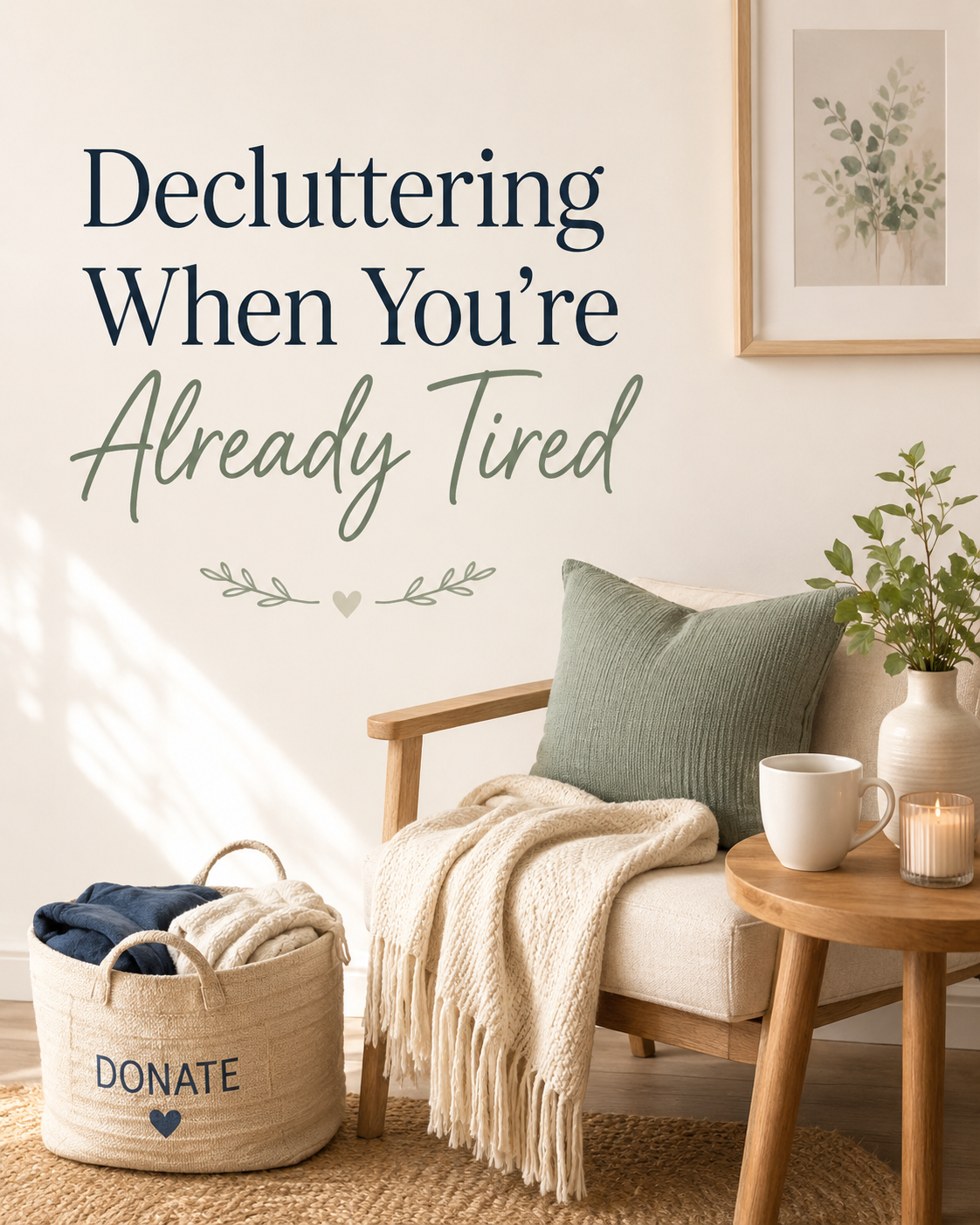
Use one bag.
When it is full, close it.
Put it in the car if you can.
Choose one drop-off day.
Or choose one donation location you already pass.
The goal is not just to remove things from the room.
The goal is to move them out of your life.
Make the next step easy.
The 10-Minute Tired Declutter
Set a timer for 10 minutes.
Choose one small area.
Minutes 1–2: Trash
Remove obvious trash only.
Minutes 3–4: Easy no
Find items you already know can go.
Minutes 5–6: Return
Put items that belong elsewhere into one basket.
Minutes 7–8: Reset
Put the most-used items back first.
Minutes 9–10: Stop
Take out the trash, close the donation bag, or place the return basket where you will see it.
When the timer ends, stop.
You are allowed to stop.
Stopping before you are drained is part of the system.
The 5-Minute Version
On very tired days, try this:
- Toss five pieces of trash.
- Put five things back where they belong.
- Find one item to donate.
- Clear one tiny surface.
- Put one basket where clutter keeps landing.
That is enough.
A five-minute reset is not “barely anything.”
It is a small act of support for your future self.
What to Avoid When You’re Tired
When your energy is low, avoid:
- sentimental boxes
- old photos
- entire closets
- whole-room resets
- paperwork that requires decisions
- selling items online
- complicated organizing products
- pulling everything out
- starting late at night
- comparing your home to anyone else’s
Tired decluttering should reduce pressure.
Not create more.
Choose tasks that give relief quickly.
Leave the heavy decisions for a better-energy day.
What Done Looks Like
Decluttering when you are tired is working when:
- one surface feels lighter
- one bag is filled
- one drawer opens easier
- one basket has breathing room
- one pile is smaller
- one category is more manageable
- one space feels less annoying
- you stopped before you felt completely worn out
Done does not mean the whole house is decluttered.
Done means one thing is easier than it was before.
That is a real win.
Keep Exploring: Maintenance, Not Overhaul
If this post helped, these gentle follow-ups may help too:
Lower-Energy Organizing Wins
A helpful next read if you want more tiny reset ideas for tired days.
What to Fix Before It Becomes a Project
Perfect if you want to catch small home annoyances before they turn into full organizing projects.
Resetting Without Starting Over
A good next step when a system has slipped, but you do not want to rebuild it from scratch.
The Summer Maintenance Reset
Helpful if your summer systems need a mid-season refresh.
Choose the post that matches your energy today.
Not the energy you wish you had.
The energy you actually have.
Try This Before You Leave
Choose one tired-day decluttering win:
- Throw away five obvious pieces of trash.
- Fill one small donation bag.
- Clear one surface.
- Put five things back.
- Empty one overflowing basket.
- Remove expired food from one fridge shelf.
- Gather papers into one tray.
- Put shoes in one bin.
- Toss dried-out pens from one drawer.
- Create one Decide Later basket with a review date.
One tiny decluttering win can make your home feel lighter without asking too much of you.
Join the Tiny Wins Club Newsletter
Want more gentle home systems like this?
Join the Tiny Wins Club Newsletter for simple organizing ideas, seasonal resets, printable guides, and tiny steps that help your home feel lighter without turning everything into a big project.
This is organizing for real life.
Tired days included.
Final Thought
Decluttering when you are already tired requires a different kind of plan.
Not more pressure.
More kindness.
Do not pull everything out.
Do not start with the hardest category.
Do not turn one small annoyance into a whole-room project.
Start with the easy no.
Use one bag.
Clear one surface.
Remove five things.
Stop before you are empty.
You do not have to do everything to make progress.
You only have to make one part of your home a little easier to live with.
Real life. Simple systems. Tiny wins.
Join the conversation—share your tiny wins with me. 💛 Hit reply or drop a comment and tell me one small thing you did today that made your home feel lighter.
Leave a Reply