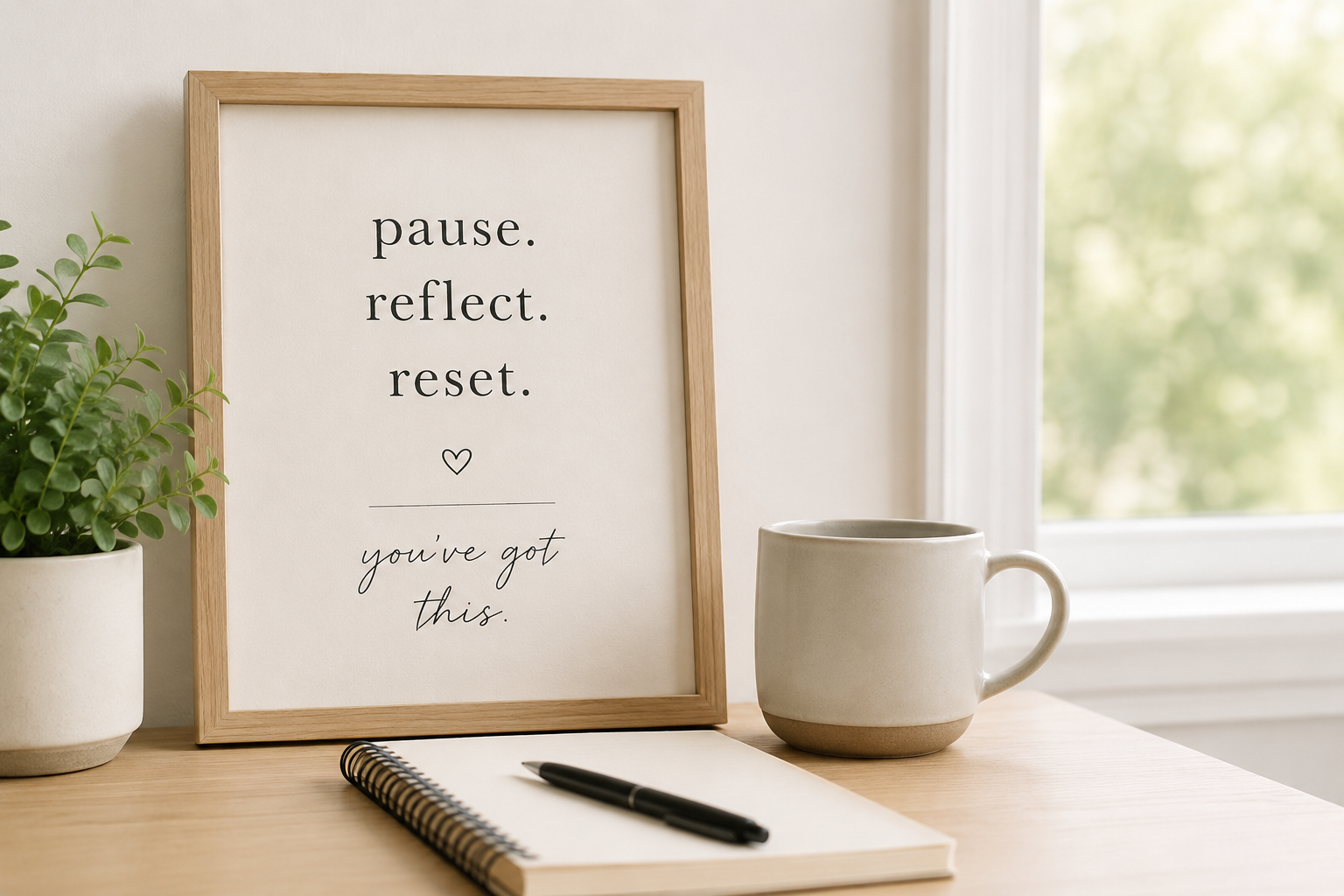
Halfway through the year is a good time to pause.
Not to judge your home.
Not to make a huge list of everything that still needs to be done.
Not to decide that you are behind.
Just to check in.
By July, your home has already carried a lot.
Winter routines.
Spring projects.
School-year schedules.
Summer snacks.
Laundry shifts.
Guests.
Busy mornings.
Late nights.
Papers.
Meals.
Drop zones.
Outdoor gear.
All the daily life that moves through your space.
And sometimes, halfway through the year, your home starts quietly telling you what is working and what is not.
A mid-year home check-in helps you notice those things before they turn into bigger problems.
This is not about starting over.
It is about asking:
What needs attention now so the rest of the year feels easier?
That one question can bring a lot of clarity.
Why a Mid-Year Check-In Matters
Most of us think about home resets at the beginning of the year.
January feels like the natural time to start fresh.
But by July, real life has tested your systems.
The routines you thought would work may have changed.
The baskets may be too full.
The kitchen may be carrying more than it should.
The calendar may be busier than expected.
The entryway may have become a drop zone again.
The pantry may need a refresh.
The laundry rhythm may need support.
The paper pile may be asking for attention.
This does not mean your systems failed.
It means your home is lived in.
And lived-in homes need check-ins.
A mid-year home check-in gives you a chance to make small adjustments before everything feels overwhelming.
Start With the Feeling
Before you look at closets, bins, drawers, and shelves, start with the feeling.
Ask yourself:
How does my home feel right now?
Does it feel calm?
Heavy?
Crowded?
Easy to maintain?
Hard to keep up with?
Supportive?
Draining?
Almost working?
Ready for a small refresh?
Your answer matters.
Because organizing is not only about how a home looks.
It is also about how a home feels to live in.
A space can look fine but still feel frustrating.
A system can look organized but still be too hard to use.
A room can be tidy but not actually support your current season.
The feeling gives you information.
Listen to it.
Walk Through Your Home Like a Friend
For this check-in, try walking through your home like a kind friend instead of a critic.
Do not look for everything that is wrong.
Look for what your home is trying to tell you.
As you walk through each area, ask:
What is working here?
What keeps getting messy?
What takes too many steps?
What do I avoid?
What feels heavier than it should?
What has become easier this year?
What needs a small adjustment?
This is not a performance review.
It is a conversation with your home.
You are noticing where support is needed.
That is all.
Check-In Area #1: The Entry or Drop Zone
Your entryway, mudroom, garage door, or back door tells a lot about your home systems.
This is where life enters.
Look at the area where your family actually comes in and out.
Ask:
Do shoes have a place to land?
Do bags have hooks or a home?
Do keys, sunglasses, and wallets have a spot?
Is mail landing where it should?
Are returns, library books, or outgoing items contained?
Does this area reset easily?
If this space is always messy, it may need fewer steps.
Maybe you need one basket for shoes.
One hook for bags.
One tray for keys.
One bin labeled Going Out.
Small changes here can make the whole home feel calmer because the entry is where daily clutter often begins.
Check-In Area #2: The Kitchen
The kitchen carries a lot of the home’s daily rhythm.
Meals.
Snacks.
Dishes.
Groceries.
Lunches.
Water bottles.
Leftovers.
Paper piles.
Family conversations.
Quick decisions.
A mid-year kitchen check-in does not have to be a full kitchen reset.
Just ask:
Are the counters usable?
Are the dishes easy to put away?
Are snacks contained?
Are leftovers visible?
Are we wasting food?
Are meal decisions feeling too hard?
Are water bottles taking over?
Is the kitchen supporting us or draining us?
If the kitchen feels heavy, choose one small system to refresh.
Maybe it is the snack zone.
Maybe it is the Eat Me First fridge spot.
Maybe it is the sink reset.
Maybe it is a short list of easy meals.
A kitchen does not need to be perfect to work better.
It just needs one less point of friction.
Check-In Area #3: Laundry
Laundry has a way of revealing whether a home system is working.
By mid-year, ask:
Where does dirty laundry pile up?
Where do clean clothes get stuck?
Are towels taking over?
Are there too many items in rotation?
Do laundry baskets have clear jobs?
Is there one step that always slows everything down?
Sometimes the fix is simple.
A basket where clothes actually land.
A towel day.
A smaller amount of towels available at one time.
A folding spot.
A donation bag in the laundry room.
A rule that clean laundry gets put away before another load starts.
Laundry rarely needs a complicated system.
It needs a rhythm that matches real life.
Check-In Area #4: Bathrooms
Bathrooms can get crowded quietly.
Half-used products.
Extra towels.
Old makeup.
Almost-empty bottles.
Expired medicine.
Hair tools.
Cleaning supplies.
Samples.
Duplicates.
A mid-year bathroom check-in can be simple.
Ask:
What do we use every day?
What is expired or almost empty?
What products are just taking up space?
Are towels easy to reach?
Are cleaning supplies close enough to make quick resets easy?
Is the counter too crowded?
This is a good place for a use it, toss it, or move it reset.
You do not have to redo the whole bathroom.
Just remove what is no longer helping.
Check-In Area #5: Paper and Plans
By July, paper can build up.
School papers.
Medical papers.
Receipts.
Coupons.
Camp forms.
Mail.
Reminders.
Lists.
Random notes.
Things you meant to handle.
Paper clutter is often delayed decision-making.
So instead of trying to sort everything at once, choose one paper landing spot.
Ask:
What papers are current?
What can be recycled?
What needs action?
What needs to be filed?
What is no longer relevant?
Where should important papers land from now on?
A simple paper system might include:
To Do
To File
To Return
This Week
Keep the categories few.
The more complicated the paper system, the less likely it is to work when life gets busy.
Check-In Area #6: Storage Spaces
Closets, cabinets, shelves, garages, and storage rooms often hold the decisions we postponed.
A mid-year check-in is not the time to empty every storage area.
Instead, look for the spaces that are starting to push back.
The closet that will not close.
The shelf where things fall.
The bin that is overflowing.
The cabinet you avoid opening.
The garage corner that keeps growing.
Choose one small storage area and ask:
Is this still useful?
Is this too full?
Is there anything obvious to remove?
Are the most-used items easy to reach?
Does this need a label, basket, hook, or clearer boundary?
Start with the obvious.
Do not turn the check-in into a full project unless you truly have the time and energy.
Maintenance comes first.
Check-In Area #7: Your Own Space
This one matters.
It is easy for home systems to focus on everyone else.
Kids’ stuff.
Kitchen needs.
Laundry.
Family schedules.
Shared spaces.
Drop zones.
Meals.
But your own space matters too.
Ask:
Do I have one calm place to land?
Is my nightstand supporting rest?
Are my clothes easy to access?
Do I have a drawer, basket, or shelf that belongs to me?
Is my paperwork contained?
Do I have a space that feels peaceful?
You are allowed to be supported by your home.
Not just responsible for it.
Even one small personal reset can make a difference.
Clear your nightstand.
Refresh your bathroom drawer.
Put a book and water by your chair.
Create one basket for your current items.
Remove five things from your closet that make you feel heavy.
Your home should have room for you too.
The Mid-Year Home Check-In Questions
Use these questions to guide your reset:
What is working well in my home right now?
What feels harder than it needs to?
What keeps becoming a pile?
What system needs maintenance?
What do I keep avoiding?
What can I simplify?
What can I stop doing?
What needs a better home?
What needs to leave the house?
What would make the next season easier?
You do not need to answer every question in one sitting.
Choose the one that gives you the most clarity.
The 30-Minute Mid-Year Home Check-In
Set a timer for 30 minutes.
Minutes 1–5: Walk through your home
Notice what is working and what feels heavy.
Minutes 6–10: Choose one area
Pick the space that would give you the most relief.
Minutes 11–20: Do a small reset
Remove trash, return items, clear one surface, or refresh one basket.
Minutes 21–25: Make one system easier
Add a label, move a bin, create a tray, simplify a category, or remove extra steps.
Minutes 26–30: Write down one next step
Not ten next steps.
One.
This keeps the check-in helpful instead of overwhelming.
What Done Looks Like
Your mid-year home check-in is working when:
- you know what is still working
- you can name what feels heavy
- one small area feels lighter
- one system has been refreshed
- one repeated problem has a next step
- you feel clearer instead of more behind
- your home feels more supportive than it did before
Done does not mean the whole house is reset.
Done means you checked in and made one thing easier.
That is enough.
Keep Exploring: Maintenance, Not Overhaul
If this post helped you see what needs support, these posts are a good next step:
The Summer Maintenance Reset
A helpful follow-up if your summer systems are starting to slip and need a mid-season refresh.
What to Fix Before It Becomes a Project
Perfect if you noticed small annoyances that need attention before they turn into bigger jobs.
Resetting Without Starting Over
A great read if one of your systems is not working, but you do not want to rebuild everything from scratch.
Decluttering When You’re Already Tired
Helpful if your check-in revealed clutter, but your energy is low.
Systems That Run on Autopilot
Read this if you want to create simple systems that reduce repeated decisions.
Choose the next post based on what your home is asking for now.
Try This Before You Leave
Choose one mid-year tiny win:
- Clear your entry basket.
- Toss expired bathroom products.
- Move leftovers to the front of the fridge.
- Refill your cleaning caddy.
- Empty one paper pile.
- Put one donation bag in the car.
- Add one hook where bags land.
- Reset one snack bin.
- Clear your nightstand.
- Write down one home system that is working.
One small check-in can change the way you move through the rest of the year.
Join the Tiny Wins Club Newsletter
Want more gentle home resets like this?
Join the Tiny Wins Club Newsletter for simple organizing ideas, seasonal check-ins, printable guides, and tiny steps that help your home feel lighter without turning everything into a project.
Real homes need check-ins.
Not judgment.
Not perfection.
Supportive systems, one tiny win at a time.
Final Thought
A mid-year home check-in is not about proving how much you have done.
It is about noticing what your home needs now.
Some systems may still be working.
Some may need a little refresh.
Some may need to be simplified.
Some things may need to leave.
Some spaces may need more support.
That is normal.
Your home changes because your life changes.
The goal is not to start over every time something slips.
The goal is to come back, adjust, and keep going.
One room.
One basket.
One surface.
One system.
One tiny win.
That is enough to begin the second half of the year with more clarity.
Real life. Simple systems. Tiny wins.
Join the conversation—share your tiny wins with me. 💛 Hit reply or drop a comment and tell me one small thing you did today that made your home feel lighter.
Leave a Reply