Laundry does not usually fall apart all at once.
It starts small.
One load stays in the washer too long.
One basket of clean clothes waits to be folded.
One pile lands on the bedroom chair.
One towel gets used and dropped.
One favorite shirt is needed but not clean.
One pair of socks disappears when everyone is trying to leave.
And then suddenly, laundry is not just laundry.
It is a routine problem.
School mornings feel harder.
Bedrooms feel messier.
Bathrooms feel crowded.
The hallway collects baskets.
Clean clothes become wrinkled.
Dirty clothes hide in corners.
And someone is asking, “Where is my shirt?” five minutes before you need to walk out the door.
That is why laundry needs a system that can hold real life.
Not a perfect laundry routine.
Not a beautiful laundry room.
Not a complicated schedule that only works when everything goes right.
A laundry system that does not break is simple, repeatable, and easy to come back to when life gets busy.
Because laundry will keep coming.
The goal is not to finish laundry forever.
The goal is to keep it moving.
Why Laundry Breaks Down
Laundry usually breaks down at the same points.
Sometimes dirty clothes do not make it to the hamper.
Sometimes laundry gets washed but not dried.
Sometimes it gets dried but not folded.
Sometimes it gets folded but not put away.
Sometimes towels, uniforms, work clothes, school clothes, pajamas, bedding, and random “needs washed” items all get mixed together.
The problem is not always the amount of laundry.
Often, the problem is the missing next step.
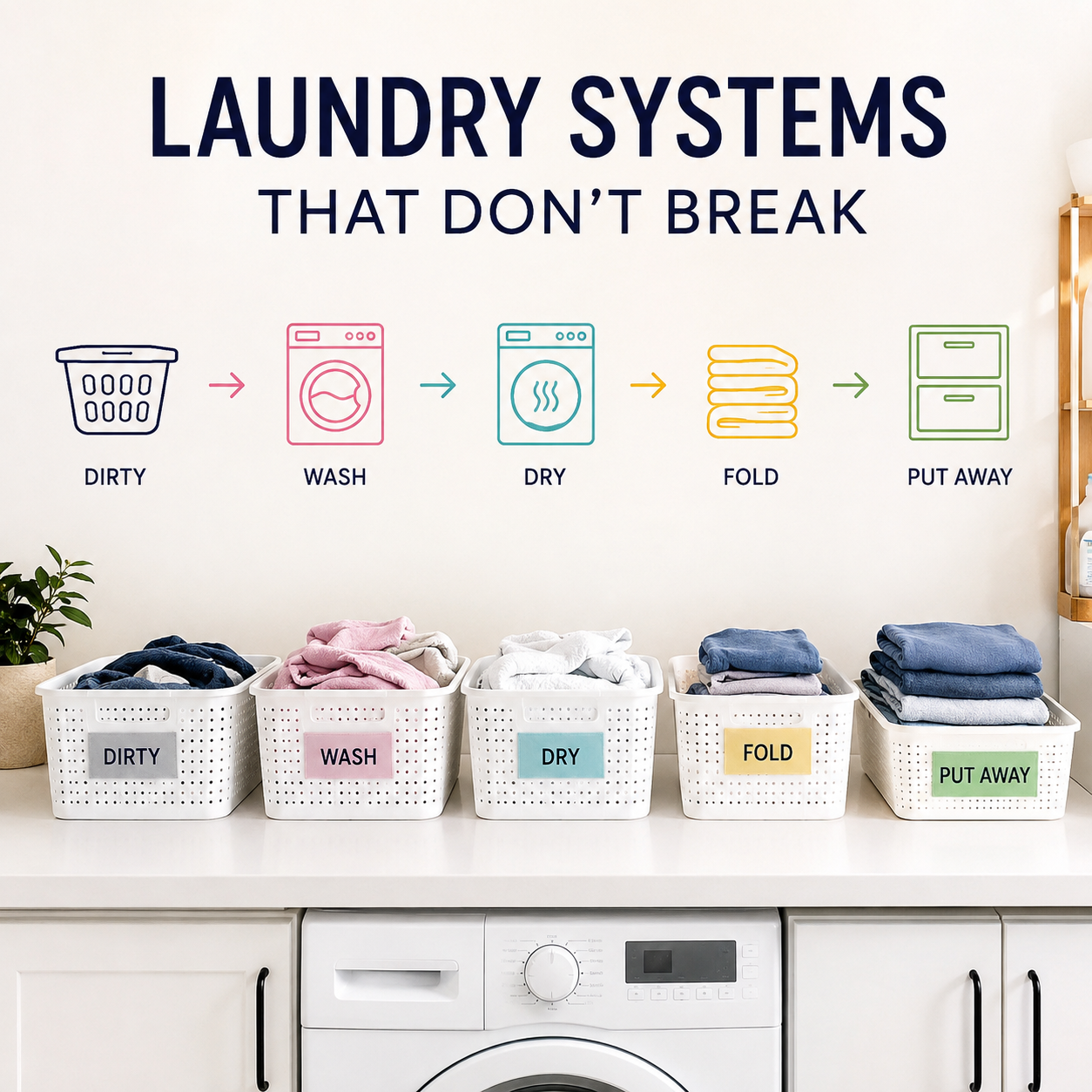
Laundry needs a path.
Dirty.
Wash.
Dry.
Fold.
Put away.
Ready to wear.
If one part of the path is unclear, the whole routine starts to back up.
So instead of asking, “Why can’t I keep up with laundry?” ask:
Where does laundry get stuck?
That question is the beginning of a better system.
Start With the Bottleneck
Every home has a laundry bottleneck.
The bottleneck is the step that slows everything down.
For some homes, the problem is gathering laundry.
For others, it is switching loads.
For others, it is folding.
For many people, the hardest part is putting clean clothes away.
Look at your current laundry routine and ask:
Where do clothes pile up?
Where do towels get dropped?
Where do clean clothes stall?
Where do people look for missing items?
What part of laundry do I avoid?
What step requires too many decisions?
What part makes mornings harder?
Do not try to fix the entire laundry system at once.
Fix the bottleneck first.
A small improvement at the stuck point can make the whole routine feel easier.
Give Dirty Laundry a Clear Home
Laundry cannot move if it never makes it to the starting point.
Dirty clothes need a clear place to land.
That might mean:
- one hamper per bedroom
- one hamper in the bathroom
- one family hamper near the laundry room
- a towel basket
- a sports clothes basket
- a small basket for socks
- a laundry bag in each closet
The best hamper is the one people will actually use.
If clothes are always on the bathroom floor, the hamper may need to be in the bathroom.
If kids drop clothes beside the bed, the hamper may need to move closer.
If towels end up in the hallway, add a towel basket where towels naturally land.
Do not build the system around where laundry “should” go.
Build it around where laundry already goes.
Then make the right choice easier.
Separate Towels Before They Take Over
Towels can break a laundry system quickly.
Bath towels.
Hand towels.
Kitchen towels.
Pool towels.
Sports towels.
Wet towels.
Clean towels that never got put away.
During back-to-routine season, towels can still be carrying summer while the rest of the house is trying to shift into school and work rhythms.
Give towels their own simple system.
Try:
- one towel hamper
- one towel wash day
- one hook per towel
- one basket for clean towels
- fewer towels in daily rotation
- a rule that wet towels never go on the floor
Sometimes the solution is not more towels.
Sometimes the solution is fewer towels available at one time.
If every towel is always in circulation, every towel can end up in the laundry.
A smaller towel rotation can make the whole system easier to maintain.
Create a “One Load Forward” Habit
A laundry system does not have to mean doing laundry all day.
Sometimes the most helpful habit is simply moving one load forward.
That means:
- dirty clothes into the washer
- washer to dryer
- dryer to basket
- basket to folded
- folded clothes to rooms
- clean clothes into drawers
One step counts.
You do not have to finish the whole cycle every time.
On busy days, ask:
What is the next step this laundry needs?
Then do that one step.
This keeps laundry from freezing in place.
A load moved forward is better than a load ignored until it becomes a problem.
Make Clean Laundry Easier to Put Away
Many laundry systems do not break in the washer.
They break after the dryer.
Clean clothes pile up because putting them away takes too many steps.
Maybe drawers are too full.
Maybe closets are crowded.
Maybe there are too many categories.
Maybe the clothes belong to multiple people.
Maybe nobody knows what goes where.
Maybe folding feels like too much.
The fix may be simpler than you think.
Try:
- one clean basket per person
- fewer clothes in each drawer
- labels for kids’ drawers
- a donation bag in the laundry area
- hooks for items worn often
- a shelf for school clothes
- a basket for pajamas
- a “put away before bed” habit
If clean clothes cannot fit easily where they belong, laundry will keep breaking at the end.
Sometimes decluttering a drawer is actually a laundry fix.
Use Baskets With Jobs
Laundry baskets work better when they have clear jobs.
Instead of random baskets floating around, assign each one a purpose.
Examples:
Dirty Clothes
For everyday laundry.
Towels
For bath, pool, or kitchen towels.
Needs Washing Today
For uniforms, work clothes, or must-have items.
Clean: Put Away
For clothes ready to return to rooms.
Donate
For clothes that no longer fit or feel good.
Repair/Stain
For items that need attention before washing or wearing.
You do not need all of these baskets.
Choose the ones that solve your real problem.
A basket without a job becomes another pile.
A basket with a job becomes a system.
Build a Back-to-Routine Laundry Reset
August is a good time to reset laundry before routines get busier.
This does not need to be a full closet overhaul.
Start with the items that affect mornings most.
Check:
- school clothes
- work clothes
- socks
- underwear
- pajamas
- towels
- sports clothes
- uniforms
- jackets or layers
- shoes that need washing
- backpacks or lunch bags that need cleaning
Ask:
What needs to be washed before the week starts?
What no longer fits?
What is worn out?
What do we keep searching for?
What needs a better home?
What can leave the laundry cycle completely?
This kind of reset makes mornings smoother because the everyday basics are easier to find.
Stop Washing What No One Uses
Laundry gets heavier when unused items stay in rotation.
Clothes that do not fit.
Towels nobody likes.
Old pajamas.
Uncomfortable socks.
Shirts that always get skipped.
Sports clothes from last season.
Extra blankets that keep landing in the wash.
As you fold or put away laundry, notice what keeps cycling through but never gets used.
Create one donation bag in or near the laundry room.
When you find something that no longer works, put it in the bag right then.
Do not wait for a whole closet cleanout.
Laundry is one of the best places to declutter because you are already touching the items.
Let the laundry routine show you what can leave.
Make a Small Stain and Repair Spot
Some laundry stalls because an item needs special attention.
A stain.
A missing button.
A tear.
A loose hem.
A shirt that needs soaking.
A backpack that needs wiping.
A lunch bag that needs cleaning.
Instead of letting those items float around, create one small stain and repair spot.
Use:
- a small basket
- a mesh bag
- a labeled bin
- a shelf in the laundry room
- a tote near the washer
Keep stain remover, a small brush, or repair supplies nearby if you use them.
The rule is simple:
If it needs extra attention, it goes here.
This keeps problem items from slowing down the whole laundry flow.
Create a Weekly Laundry Rhythm
A laundry rhythm does not have to be strict.
It just needs to be predictable enough that laundry keeps moving.
You might choose:
Monday: clothes
Wednesday: towels
Friday: bedding
Sunday: school/work clothes reset
Or:
One load every morning.
One load after dinner.
Towels twice a week.
Everyone puts away their basket on Sunday.
The best rhythm is the one that fits your real life.
If your week is busy, keep the rhythm simple.
If weekends are full, do not make Sunday the only laundry day.
If mornings are chaotic, move laundry to evenings.
A laundry system that fights your schedule will not last.
A laundry system that fits your schedule has a much better chance.
The 15-Minute Laundry Rescue
When laundry already feels behind, do not start by trying to do everything.
Try a 15-minute rescue.
Minutes 1–3: Gather
Collect laundry from the main places it piles up.
Minutes 4–6: Sort
Separate clothes, towels, and must-wash items.
Minutes 7–9: Start or move one load
Get one load moving forward.
Minutes 10–12: Clear one clean basket
Fold, hang, or deliver one basket to the right room.
Minutes 13–15: Remove what does not belong
Put one item in the donation bag, toss trash, or move non-laundry items out of the laundry space.
Then stop.
The goal is not to finish all laundry.
The goal is to unstick the system.
Make It Easier for Kids to Help
Kids can help with laundry when the system is clear.
Start small.
Younger kids can:
- put dirty clothes in the hamper
- match socks
- place towels in a basket
- carry their clean basket to their room
- put pajamas in one drawer
Older kids can:
- start a load
- switch laundry
- fold simple items
- put away their own clothes
- check uniforms or school clothes
- bring laundry down on a set day
The key is to make the job specific.
“Help with laundry” is vague.
“Put your clean clothes in your top two drawers” is clear.
A simple instruction works better than a big expectation.
What Done Looks Like
Your laundry system is working when:
- Dirty clothes have a clear place to land
- Towels are not taking over the whole routine
- Clean laundry has a next step
- Clothes are easier to put away
- Must-have items are easier to find
- Laundry moves forward regularly
- Baskets have clear jobs
- The system can recover when it slips
- Mornings are not derailed by missing clothes
Done does not mean every piece of laundry is finished.
Done means laundry is moving.
That is the win.
Keep Exploring: Build on What Already Works
If laundry is only one part of your back-to-routine reset, these related posts can help:
Back-to-Routine Without the Rush
A gentle starting point if your home is shifting from summer into fall routines.
The School Morning Launch Pad
Helpful if missing shoes, backpacks, lunch boxes, papers, and water bottles are making mornings harder.
Resetting the Landing Zones
A good next read if laundry is piling up alongside bags, shoes, papers, keys, and everyday items that need better landing spots.
Decluttering When You’re Already Tired
Perfect if laundry is revealing clothes, towels, or linens that no longer need to stay in rotation.
Systems That Run on Autopilot
Read this if you want laundry and other household routines to become simple enough to maintain with fewer reminders.
Choose the post that matches the part of your routine that keeps getting stuck.
Try This Before You Leave
Choose one laundry tiny win:
- Start one load.
- Move one load forward.
- Put one clean basket away.
- Create a towel basket.
- Add a donation bag to the laundry room.
- Gather laundry from one room.
- Match socks, or missing pieces.
- Choose one towel wash day.
- Label one basket.
- Clear one laundry surface.
One small step can keep the laundry system from breaking completely.
Join the Tiny Wins Club Newsletter
Want more simple home systems like this?
Join the Tiny Wins Club Newsletter for free gentle organizing ideas, seasonal resets, blog updates, and tiny steps that help your home feel lighter without turning every routine into a project.
The free version is a simple way to stay encouraged and keep building small habits.
For readers who want more structure, the paid version includes deeper support such as printable guides, extended reset plans, step-by-step worksheets, seasonal checklists, and more detailed HOMe systems you can work through at your own pace.
Start with the free version if you want encouragement and ideas.
Upgrade to the paid version when you want the printables, deeper guides, and extra tools to help you follow through.
Real homes do not need perfect laundry routines.
They need systems that can recover.
Final Thought
Laundry does not have to be perfectly finished to be working.
It just needs to keep moving.
Dirty clothes need a home.
Towels need a plan.
Clean laundry needs a next step.
Baskets need jobs.
Must-have items need to be easy to find.
The system needs a way to recover when life gets busy.
That is what makes a laundry system strong.
Not perfection.
Movement.
One load forward.
One basket cleared.
One towel system reset.
One tiny win.
Real life. Simple systems. Tiny wins.
Join the conversation—share your tiny wins with me. 💛 Hit reply or drop a comment and tell me one small thing you did today that made your home feel lighter.
Leave a Reply