Paper clutter has a way of showing up quietly.
One envelope on the counter.
One school form on the table.
One receipt in your purse.
One appointment reminder on the fridge.
One permission slip by the backpack.
One coupon you might use.
One paper you are afraid to throw away.
And then suddenly, there is a pile.
Not because you are messy.
Because paper asks for decisions.
Read this.
Sign this.
Pay this.
Return this.
Save this.
Recycle this.
File this.
Remember this.
Paper clutter is not just clutter.
It is delayed decision-making.
That is why paper systems need to be simple, visible, and easy to repeat.
A paper system that sticks does not require you to become a filing expert.
It just gives paper a place to land before it takes over your counters, tables, backpacks, bags, and brain.
Why Paper Clutter Builds So Fast
Paper comes into the house from everywhere.
Mail.
School folders.
Work papers.
Receipts.
Medical papers.
Bills.
Invitations.
Coupons.
Schedules.
Permission slips.
Sports forms.
Homework.
Library notices.
Donation receipts.
Random notes.
Things printed “just in case.”
And each piece asks something different from you.
Some papers need action.
Some need to be saved.
Some need to leave the house again.
Some are just information.
Some are trash pretending to be important.
That is why one giant paper pile rarely works.
A pile hides the next step.
A simple system shows the next step.
That is the difference.
Start With One Paper Landing Spot
The first paper clutter solution is not a file cabinet.
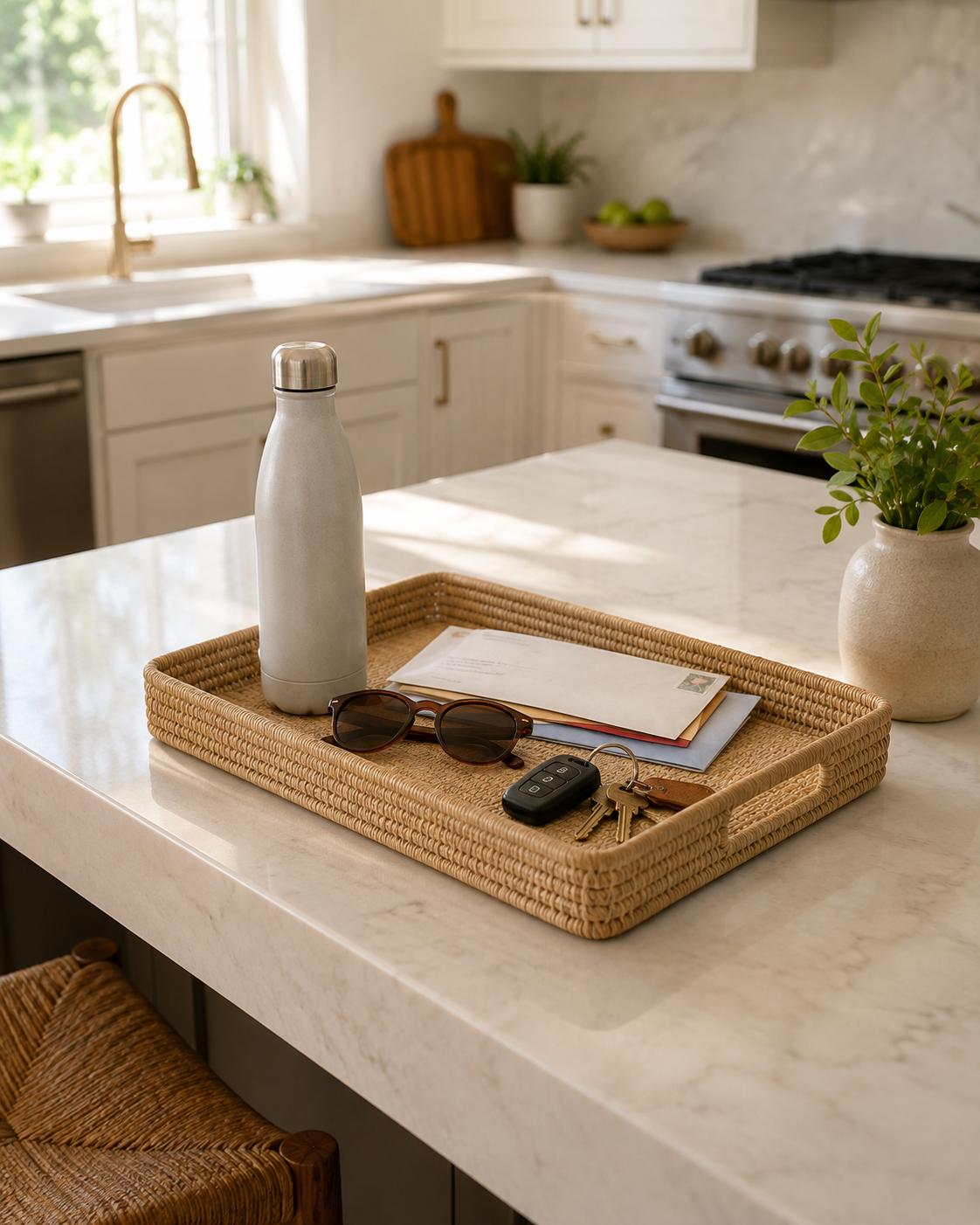
It is a landing spot.
You need one place where new paper goes when it enters the house.
Not five places.
One.
This might be:
- a tray on the counter
- a basket near the command center
- a wall pocket
- a clipboard
- a folder
- a shallow bin
- a drawer near the kitchen
- a small desktop sorter
The goal is to stop paper from spreading.
Before you create categories, create containment.
A paper landing spot says:
Papers go here first.
That one rule can make the whole house feel calmer.
Do Not Let the Landing Spot Become Storage
A landing spot is for new paper.
It is not where paper lives forever.
This is where many paper systems break down.
The tray starts as a helpful place.
Then it becomes a stack.
Then the stack becomes a pile.
Then the pile becomes something you avoid.
The fix is a reset rhythm.
Choose when you will clear the landing spot.
Maybe:
- every evening
- every Sunday
- before trash day
- before grocery day
- when the tray is full
- after school papers come home
- during your weekly reset
The landing spot only works if paper keeps moving through it.
Think of it like a doorway, not a storage room.
Sort Paper by Action, Not by Emotion
Many people get stuck because they try to decide the final home for every paper right away.
That can feel too heavy.
Instead, sort by action.
Ask:
What needs to happen next?
Use simple categories:
To Do
Bills, forms, calls, appointments, anything needing action.
To Sign
Permission slips, school forms, medical forms, documents requiring a signature.
To Return
Library slips, school papers, items that need to go back in a backpack, bag, or car.
To File
Papers you truly need to keep long-term.
This Week
Schedules, reminders, event details, meal plans, sports info, anything current.
Recycle/Shred
Junk mail, old papers, expired coupons, duplicates, unnecessary envelopes.
These categories work because they tell you what to do next.
That is what makes the system stick.
Keep Categories Few
A paper system with too many categories can become another project.
You do not need a folder for every possible type of paper.
You need categories you will actually use.
For most homes, three to five categories are enough.
A very simple system could be:
To Do
To Return
To File
This Week
Recycle (aka: the trash)
For school routines, you might use:
To Sign
To Return
Keep This Week
Artwork/Memory
Recycle (aka: the trash)
For household papers, you might use:
Bills
Action
File
Shred (aka: the trash)
The best paper system is not the most detailed.
It is the one you can use quickly when life is busy.
Create a “Today or This Week” Spot
Some papers are not forever papers.
They are just current papers.
Schedules.
Invitations.
School lunch menus.
Sports calendars.
Appointment reminders.
Event details.
Coupons you genuinely plan to use.
These papers need to be visible, but only for a short time.
Create a This Week spot.
This might be:
- one clipboard
- one fridge clip
- one wall pocket
- one command center tray
- one folder
- one magnetic board
The key is to clear it weekly.
If it is no longer current, it leaves.
This keeps helpful papers from becoming outdated clutter.
Give School Papers a Simple Path
School papers need a very clear system because they come in often and usually require action.
Try this path:
Step 1: Backpack gets emptied daily
Even if it is only a quick check.
Step 2: Papers go into one landing spot
Not left in the backpack, not scattered on the table.
Step 3: Sort into three simple groups
Sign/Return
Keep This Week
Recycle (aka: the trash)
Step 4: Returned papers go back to the launch pad
Once signed or handled, they go straight to the backpack or Going Out bin.
This system helps because it closes the loop.
A paper does not just land.
It moves.
That movement is what prevents clutter.
Use a Clipboard for Papers That Need Action
Clipboards are simple and underrated.
They work because they hold papers together, make the stack portable, and create a clear boundary.
Try one clipboard for:
- forms to sign
- bills to pay
- school papers
- medical papers
- this week’s reminders
- household tasks
- papers to discuss with someone
A clipboard is especially helpful if papers tend to move from counter to table to desk to bag.
Instead of a loose pile, you have one contained action stack.
Label it if needed:
To Sign
To Handle
This Week
Simple tools often work better than complicated systems.
Make a Going-Out Paper Spot
Some paper clutter happens because a paper needs to leave the house again.
Permission slips.
Library notices.
Signed forms.
Receipts to return.
Appointment paperwork.
Sports forms.
Documents for work.
Things that need to go in the car.
These papers need a Going Out spot.
This can be part of your school morning launch pad.
Use:
- a folder
- a basket
- a wall pocket
- a clip
- a tray near the door
- one envelope per child
The rule is simple:
If it needs to leave the house, it does not stay on the counter.
It goes in the Going Out spot.
Stop Saving Papers You Can Find Elsewhere
This is a quiet paper clutter habit.
We save papers because we are afraid we might need the information later.
But many papers are available online, in an app, in an email, or from the school or office.
Before keeping a paper, ask:
Can I find this information somewhere else?
Do I truly need the paper copy?
Will I know where to find it if I keep it?
Is this current?
Is this legally or financially important?
Is this just a reminder I could write down instead?
If the paper is only a reminder, transfer the information to your calendar, notes app, planner, or command center.
Then let the paper go.
Paper should not have to hold every reminder in your life.
Create a Small Long-Term File
Some papers do need to be kept.
Not every paper belongs in long-term storage.
Long-term files might include:
- tax documents
- insurance papers
- medical records
- important legal documents
- warranty information
- major receipts
- property documents
- school records you truly need
- financial documents
- identification copies stored safely
Keep long-term filing separate from daily paper flow.
Daily paper should not live in the same pile as long-term records.
Use a file box, folder system, binder, or cabinet.
The simpler the better.
And remember: filing is not the first step.
Sorting is.
Only file what truly needs to stay.
Handle Artwork and Memory Papers Differently
Kids’ artwork, sweet notes, certificates, photos, and memory papers can slow the whole paper system down.
They are not normal papers.
They carry emotion.
Do not mix them with bills, forms, and mail.
Create one memory paper spot.
This could be:
- one keepsake box per child
- one folder for the year
- one art portfolio
- one photo box
- one temporary display area
The rule might be:
Display favorites for a while, then choose what stays.
You do not have to keep every paper to honor the child or the memory.
Keep the ones that truly feel meaningful.
Let the rest be part of the season.
The 10-Minute Paper Reset
Set a timer for 10 minutes.
Choose one paper pile.
Minutes 1–2: Remove obvious trash
Envelopes, junk mail, duplicates, expired flyers.
Minutes 3–4: Pull out action papers
Anything to sign, pay, return, call about, or handle.
Minutes 5–6: Pull out current papers
This week’s schedules, reminders, and event details.
Minutes 7–8: Create simple homes
To Do, To Return, This Week, To File, Recycle.
Minutes 9–10: Move one paper forward
Sign it, put it in a bag, recycle it, file it, or add the date to your calendar.
Do not try to finish every paper.
Try to move the pile forward.
That is a tiny win.
What Done Looks Like
Your paper system is working when:
- paper has one place to land
- important papers are easier to find
- papers are sorted by next action
- school forms have a return path
- outdated papers leave regularly
- the counter is not the main filing system
- you know what needs attention this week
- paper feels less like a mystery pile
- the system can be reset quickly
Done does not mean there is never paper in your home.
Done means paper is moving instead of piling.
Keep Exploring: Build on What Already Works
If this post helped, these already-created posts can support your back-to-routine systems:
Back-to-Routine Without the Rush
A gentle starting point for easing into August routines without overhauling the whole house.
The School Morning Launch Pad
A practical companion if papers need to leave the house with backpacks, lunch boxes, shoes, and water bottles.
Drop Zones That Actually Work
Helpful if papers are only one part of a larger landing-zone problem with bags, keys, shoes, and daily items.
A Summer Command Center
Useful if you want one simple household hub for calendars, reminders, papers, and going-out items that can be adjusted for August.
Systems That Run on Autopilot
Read this if you want your paper system to become simple enough to maintain without constant decision-making.
Choose the post that matches the place where paper keeps getting stuck.
Try This Before You Leave
Choose one paper clutter tiny win:
- Put one tray where papers already land.
- Recycle five old papers.
- Create one To Return folder, clipboard, or basket.
- Clip papers that need signatures to one clipboard.
- Clear old papers from the fridge.
- Put school papers in one basket.
- Move one reminder to your calendar.
- Create a This Week spot.
- Put a shred bag near your paper area.
- Choose one weekly paper reset time.
One clear paper home can make the whole routine feel lighter.
Join the Tiny Wins Club Newsletter
Want more simple back-to-routine systems like this?
Join the Tiny Wins Club Newsletter for gentle organizing ideas, seasonal resets, printable guides, and tiny steps that help your home feel lighter without turning every paper pile into a project.
Real homes have paper.
The goal is not zero paper.
The goal is paper that has a path.
Final Thought
Paper clutter sticks around because paper asks for decisions.
But your home does not need a complicated filing system to feel better.
It needs a simple path.
A landing spot.
A few action categories.
A weekly reset.
A Going Out place.
A way to handle school papers.
A separate space for long-term records and memories.
That is enough to begin.
When paper has a path, it stops taking over every surface.
Real life. Simple systems. Tiny wins.
Join the conversation—share your tiny wins with me. 💛 Hit reply or drop a comment and tell me one small thing you did today that made your home feel lighter.
Leave a Reply